Female Friendship as Palace Warfare
How female friendship becomes tenderness, leverage, betrayal, and quiet protection across Tia Shan's three palace tragedies.
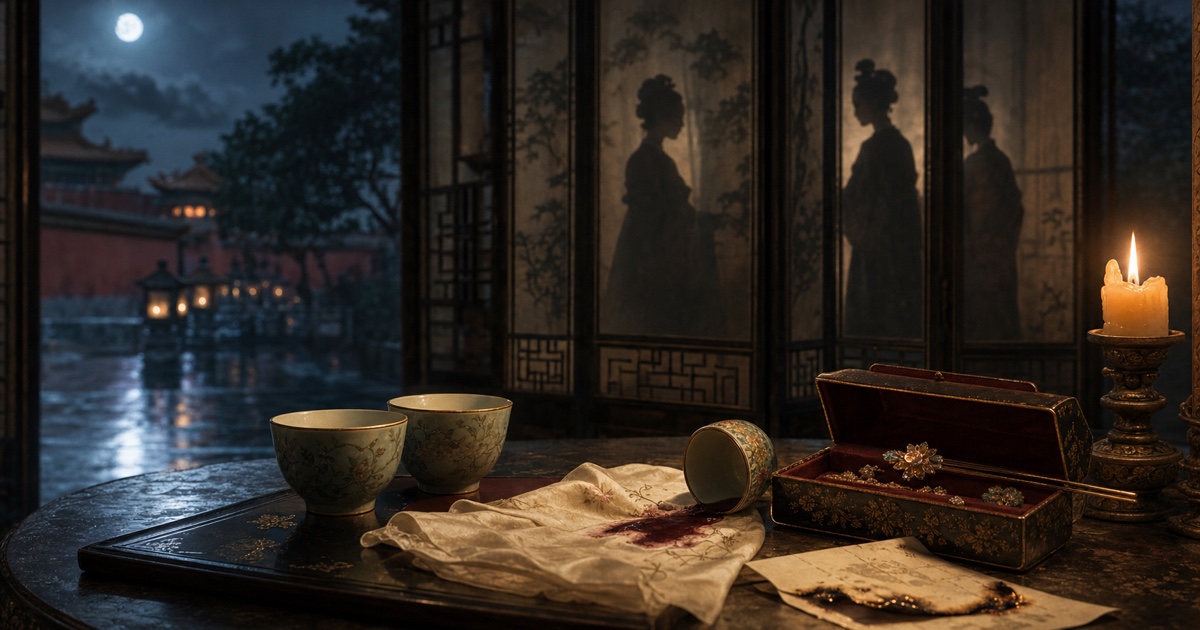
I am always a little wary when people describe female friendship in palace fiction as a refuge. Sometimes it is. Sometimes it is the only warmth left in a place built to measure women against one another. But inside a palace, even warmth has consequences. A friend can become a witness, a temptation, a rival, an alibi, or a weakness someone else can press until it bruises. That does not mean women are naturally cruel to one another. It means the structure is cruel first, and then it teaches everyone how to survive inside it. Across my three palace tragedies, friendship is one of the tenderest forces in the room. It is also one of the most dangerous.
Light-to-medium spoilers follow for relationship dynamics across all three books. I avoid final twists, but I do discuss major friendship wounds already established in earlier reader posts.
A palace makes every kindness political
In an ordinary household, a gift can be a gift. In a palace, a gift can be gratitude, bribery, apology, ranking, surveillance, or a warning wrapped in silk. A woman visits at a meaningful hour, sends medicine at a meaningful time, praises someone in front of the Emperor, or fails to. Every small action begins to carry rank.
This is why the Palace Titles Guide matters beyond vocabulary. A title decides who may sit, who must kneel, whose grief sounds respectable, and whose friendship can be mistaken for factional ambition. The palace is a machine for turning feeling into hierarchy.
Book 1: A-Jiao and A-Shuo, the friendship that became a ghost
In The Emperor’s Caged Bride, the central female friendship has already ended before the book begins. A-Shuo is dead, but she is not gone.
To A-Jiao, A-Shuo was not only the first Crown Princess or the perfect cousin whose place she is forced to take. She was part of girlhood: the graceful elder figure who laughed at A-Jiao’s strange ideas, drank osmanthus wine with her under the moon, and belonged to a time before every person in the room became a title.
Then the palace closes over them. A-Jiao’s marriage does not only steal her own future. It turns her memory of A-Shuo into a test she can never pass. The dead cousin becomes a standard, a mask, a perfume recipe, a way of smiling, a way of crying. A-Jiao is not allowed to mourn A-Shuo cleanly because she must also imitate her.
That is a quieter kind of warfare. The palace takes a bond that was once affectionate and turns it into a cage. This is why I wrote separately about A-Shuo’s ghost: she never appears alive in the main present, yet she shapes every intimate room.
Book 2: Yueying, Mianmian, Yunnong, and Shuer
The Cloud Beside the Moon is the friendship book because it gives friendship more shapes than any single moral can hold.
At first, Yueying’s warmth in the Eastern Palace comes through Hu Mianmian. Mianmian is foolish sometimes, dramatic often, and sincere in a way the palace is not designed to protect. She clings to Yueying, complains, envies, dreams, and loves the Crown Prince with a brightness that has no political armor.
Qin Yunnong makes that friendship triangle sharper because she is not a simple villain in the early shape of the story. She is gracious. She shares sweets, household talk, and the daily performance of harmony. Yueying understands her pressure: a principal wife of lower birth must work twice as hard, love twice as carefully, and make no visible mistake.
Almost is the dangerous word. Yunnong understands what Mianmian’s softness can be used for: timing, illness, access, and the cruel precision of letting another woman’s heart keep hurting without ever seeming to lift a hand. That is why her betrayal cuts so deeply. It does not look like hatred. It looks like care arranged at the wrong moment.
After Mianmian dies, Yueying’s grief becomes strategy. The friend who loved too brightly becomes the reason Yueying stops believing that innocence can protect anyone. I wrote more about why this book is not a romance in this spoiler-light guide, but the friendship angle is its own wound: Yueying’s revenge begins as loyalty to the dead.
Wen Shuer complicates everything again. Her loyalty is practical: palace affairs, children, illness, prayer. But even Shuer’s devotion is not innocent forever. Sometimes a friend protects you by standing between you and the world. Sometimes she protects you by committing the sin you would not have asked for, then carrying it alone until it destroys her.
Book 3: Changning and the women left after the fire
By the time The Emperor’s Last Lie begins, Changning has already lost her first world: birth name, family, first husband, political place, and the young woman who once moved beside her like a sister. When she enters the harem as Ye Changning, she is walking into the ruins of several older female tragedies, some visible and some carefully misnamed.
That is why her first important relationship in the palace is not glamorous. It is Yinyuan.
Yinyuan begins as a maid who openly looks down on her. Their bond is funny before it is moving: Yinyuan scolds, panics, gossips, rolls her eyes, and silently begs Changning to hold her tongue before someone gets them both killed. In a palace where most women approach through rank, Yinyuan approaches through daily survival. She is not Changning’s equal in status, but she becomes one of the few people who sees the daily cost of Changning’s refusal to perform properly.
Consort Wan is a different kind of friend: higher ranked, older in grief, and much more dangerous.
She tests Changning. She manipulates information. She turns a forbidden paper-burning ritual into a trap and a shield at the same time. She can be maddening, theatrical, evasive, and absurdly funny. Yet she is also one of the only women in the palace who understands that public narratives are almost always false. Wan does not give Changning a safe place outside the palace. No one can. What she gives is a second pair of eyes inside the palace’s lies.
Concubine Shen belongs to the article more quietly. She is not Changning’s close friend in the simple sense. She is cold, self-contained, and understood by everyone through the wrong story. Only after her death does the truth rearrange her life into something more tragic and more dignified. Through Shen, Changning sees another woman whose apparent devotion may be covering a grave no one else can name.
That matters because The Emperor’s Last Lie is full of women who have been misread so long that even their grief has been assigned the wrong owner. Friendship, in that world, begins with the act of seeing correctly. It is not girlhood intimacy anymore. It is the fragile alliance of women who have outlived too much and are still trying, in their crooked ways, to keep one another from disappearing entirely.
Why I do not write simple sisterhood
I love stories where women save one another. I also distrust stories that make saving look clean.
In these books, women do save one another. A dead cousin preserves the memory of a freer girl. A lovesick friend gives Yueying the last pure tenderness the Eastern Palace can offer. A frightened maid tells the truth. A later consort stays beside an Empress until loyalty becomes both prayer and guilt. A false invalid shields another woman through performance.
But none of it happens outside power. The palace makes women compete for rank, favor, children, legitimacy, and the right to be believed. It teaches them to read every kindness as a possible move. That is female friendship as palace warfare: not women destroying one another because they are women, but women trying to remain human in a structure that keeps handing them weapons.
What to do next
If you are new to these books, start with Three Books, Three Palaces for the spoiler-light map of all three tragedies, then choose your doorway from the Books page.
If you need content notes before entering the inner palace, the Reader’s Guide is the gentler place to begin. If you want the most friendship-heavy read first, choose The Cloud Beside the Moon. If you want the quietest and strangest version of female alliance, choose The Emperor’s Last Lie.
And if you ever feel tempted to ask whether these women are friends or enemies, the answer is usually: yes.
Tia
A free story for new readers
The Empress He Could Not Keep — a complete short story
of empire, obsession, and the impossible return.
Yours when you join the reader list.