Three Books, Three Palaces: A First Look at The Emperor's Last Lie
A spoiler-light guide to Tia Shan's three palace tragedies, and how The Emperor's Last Lie changes the shape of the imagined dynasty series.
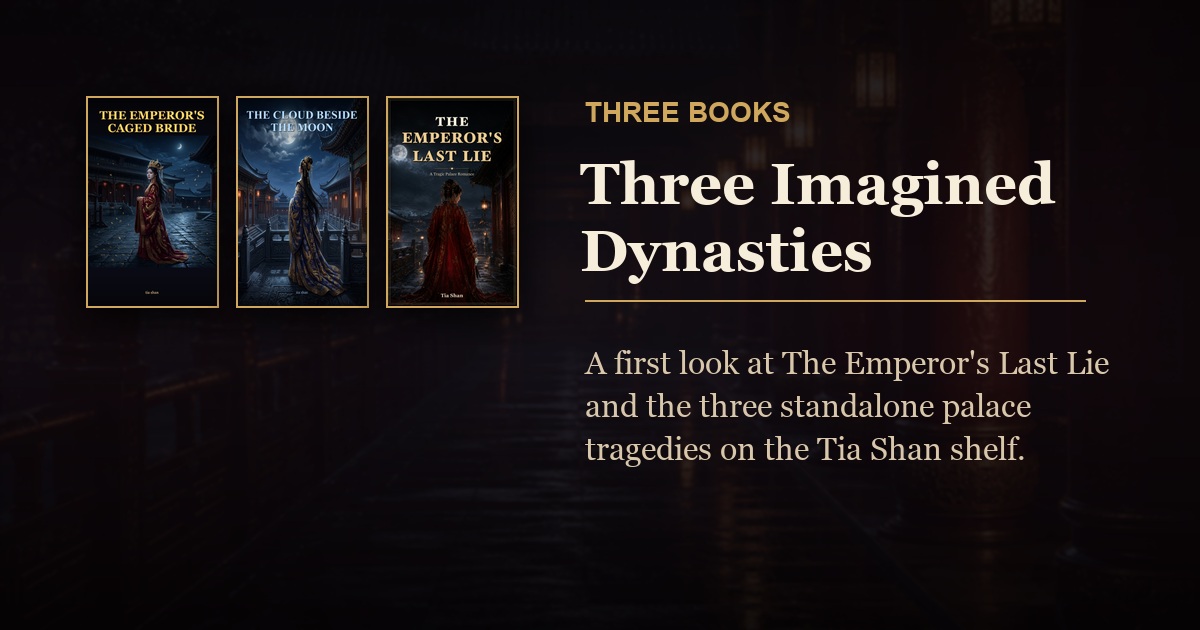
For a while, this site had a quiet imbalance. I had written about palace tragedy, morally grey heroines, imagined dynasties, and the first two books often enough that A-Jiao and Yueying had already found rooms here. Changning was present, but still standing half in shadow. That changes today. The Emperor’s Last Lie is not a sequel to the first two books, and you do not need to read anything else before opening it. But it is the third answer I have written to the same old question: what happens when a woman is given a place inside the palace, and the place is not designed to let her remain whole?
This is a spoiler-light first look. I will discuss premise, structure, emotional pressure, and reading order. I will not discuss the final reveal.
What links the three books
All three books are set in imagined Chinese dynasties. That phrase matters to me, and I wrote a fuller note about it in What Is an Imagined Dynasty?. The short version is this: the dynasties are invented, but the pressure is historical.
I am not trying to recreate one documented court year by year. I am trying to write rooms where titles hurt, family duty has teeth, marriage is never purely private, and the inner palace is never separate from the state. A real dynasty would bring its own exact record. An imagined one lets me stay close to the heroine without making her borrow a real woman’s grave.
That is the first shared thread: the palace as structure.
In The Emperor’s Caged Bride, A-Jiao enters Great Zhou’s court as a replacement bride. Her cousin A-Shuo is dead, but the Cui family still needs a daughter beside the Crown Prince. A-Jiao is not chosen because the palace sees her heart. She is chosen because a position has opened, and her body can be moved into it.
In The Cloud Beside the Moon, Ruan Yueying enters the Eastern Palace as Secondary Consort, not Crown Princess. That lower title becomes a wound before anyone has to say a cruel word. Her story is about revenge, but the revenge begins in rank: who stands first, who receives respect, who is allowed to matter, and what happens when a woman learns to use the same palace grammar that injured her.
In The Emperor’s Last Lie, Ye Changning is brought back from Anyuan Temple after seven years of disappearance. To the court, she is a woman with a dangerous resemblance to a dead favorite. To Emperor Li Chengmu, she is someone else entirely: the girl he loved, lost, failed to protect, and refuses to lose again. Her first problem is not simply whether he loves her. It is whether his love has already rewritten too much of her life.
Three books. Three courts. Three women who are never allowed to be ordinary.
The second shared thread is moral complexity.
These are not stories where the heroine suffers beautifully and remains untouched by the system. A-Jiao’s obedience becomes morally dangerous. Yueying’s justice hardens into revenge. Changning’s survival becomes armor sharp enough to wound anyone who comes too near. I wrote more about that shape of character in What Makes a Morally Grey Heroine Compelling?, but the basic rule is simple: damage explains a woman. It does not wash her clean.
The third thread is the absence of guaranteed happy endings.
That does not mean the books are written to punish readers. It means the palace is taken seriously. If power, family, love, succession, reputation, and memory all press on one woman at once, a neat romantic rescue can become dishonest very quickly. Palace tragedy is the genre that keeps asking what is left after the official version of victory has been written down.
What is different about The Emperor’s Last Lie
The Emperor’s Last Lie belongs with the first two books, but it moves differently.
The Emperor’s Caged Bride is a slow heartbreak built around replacement. A-Jiao is placed where A-Shuo used to stand. The tragedy tightens as rank becomes confinement, and Weiyang Palace becomes the beautiful room she cannot leave. If that is the wound that calls to you, start there.
The Cloud Beside the Moon is a long revenge story. Yueying is not only trying to punish a rival. She is trying to answer a violation, a death, and the realization that friendship in the palace can be turned into a weapon. Its emotional clock is not a courtship clock. It is an attrition clock. It asks what twenty years of anger can preserve, and what it consumes.
The Emperor’s Last Lie has a more mystery-shaped spine.
When Changning enters the palace, she is already living after catastrophe. Her former husband, the Crown Prince, is dead. Her family has been destroyed for treason. She has spent seven years at Anyuan Temple, far from the court’s daily violence, until Li Chengmu pulls her back into the harem.
From the outside, the premise looks almost familiar: a woman becomes a substitute for a dead beloved. The court thinks it knows how to read her. It sees resemblance, imperial favor, jealousy, and danger. That is the surface story.
But the book keeps asking a quieter question underneath: what if the substitute story is itself a mask?
That is where the mystery structure begins. There are old witnesses who should not still matter. There are women in the harem who appear cruel, ill, foolish, or decorative until their survival strategies come into focus. There are pregnancies used as political shields, deaths staged or misread, letters destroyed, and memories that do not match the official account. The palace is not only a cage in this book. It is an archive where someone has been burning pages.
This is also the book with the clearest “love story told in reverse” feeling.
Many romances begin with strangers meeting and slowly discovering a shared past. Changning and Li Chengmu begin with too much past. The reader enters after the love, after the separation, after the rebellion, after the executions, after the temple years. What remains is not the question of whether feeling exists. It does. That is part of the problem.
The real question is whether feeling can survive truth.
Li Chengmu is not written as a clean romantic savior. He is tender, manipulative, ruthless, strategic, and terrified of leaving Changning unprotected. He arranges the board around her, often without asking whether she wants the position he is building. He withholds truth because he thinks truth will destroy her. He lies because he believes a lie can be mercy.
Changning, for her part, is not simply a wounded woman waiting to be loved correctly. She is funny, cold, proud, suspicious, and more alive than the court expects. She refuses to let the harem decide whether she is a replacement, a relic, a threat, or a reward. She has already survived being used by history. She is not eager to become useful again.
That tension gives the book its shape. It is childhood love after political ruin. It is forbidden love inside the harem. It is a palace mystery wrapped around a dying Emperor and a woman who has to decide what she can bear to know.
Why the third book changes the shelf
Before The Emperor’s Last Lie, the first two books already spoke to each other.
A-Jiao and Yueying are almost opposite answers to palace harm. A-Jiao yields for too long. Yueying refuses to yield and discovers that winning can stain her hands. One is trapped by passivity wearing the costume of duty. The other is transformed by revenge wearing the costume of justice.
Changning adds a third shape: disappearance.
She has already lost the household, the husband, the family name, and the ordinary future. For seven years, Anyuan Temple gives her a kind of absence. It is not freedom exactly, but it is distance. When the Emperor brings her back, the palace tries to make her legible again. It gives her a rank. It gives her a role. It gives everyone a rumor that explains her too quickly.
The third book asks what happens when survival has been built on not being seen, and then the most powerful man in the world insists on seeing you through his own guilt.
That is why Changning changes the shelf for me. She is not the naive bride. She is not the woman beginning her revenge. She is the woman after the disaster, the one who has already learned how history can swallow a life and keep walking. Her tragedy is not that she does not know the palace is dangerous. Her tragedy is that knowledge does not always give you a clean way out.
Where to start
All three books stand alone, so start with the wound that finds you first.
Choose The Emperor’s Caged Bride if you want slow heartbreak, a replacement bride, a dead first wife whose absence fills every room, and a golden cage that becomes literal.
Choose The Cloud Beside the Moon if you want long revenge, female friendship as palace warfare, a morally complicated heroine, and the cost of learning how to win inside a system built to injure you.
Choose The Emperor’s Last Lie if you want palace mystery, a substitute consort, childhood lovers separated by political catastrophe, a dying Emperor, and a love story where the final truth arrives too late to make the past merciful.
If you are completely new to this corner of fiction, begin with the Reader’s Guide for content notes and reading order, or with A Beginner’s Guide to Chinese Palace Angst for genre context. If titles like Crown Princess, Secondary Consort, or Empress Dowager are tripping you up, keep the Palace Titles Guide open.
And if Changning is already the one pulling at you, go straight to The Emperor’s Last Lie. It is on Kindle and Kindle Unlimited.
Just know the shape of the door before you enter:
The dynasty is imagined. The loss is not.
Tia
A free story for new readers
The Empress He Could Not Keep — a complete short story
of empire, obsession, and the impossible return.
Yours when you join the reader list.