What Is an Imagined Dynasty?
Why Tia Shan writes Great Zhou and other invented Chinese dynasties, and how fiction can stay close to history without pretending to be the record.
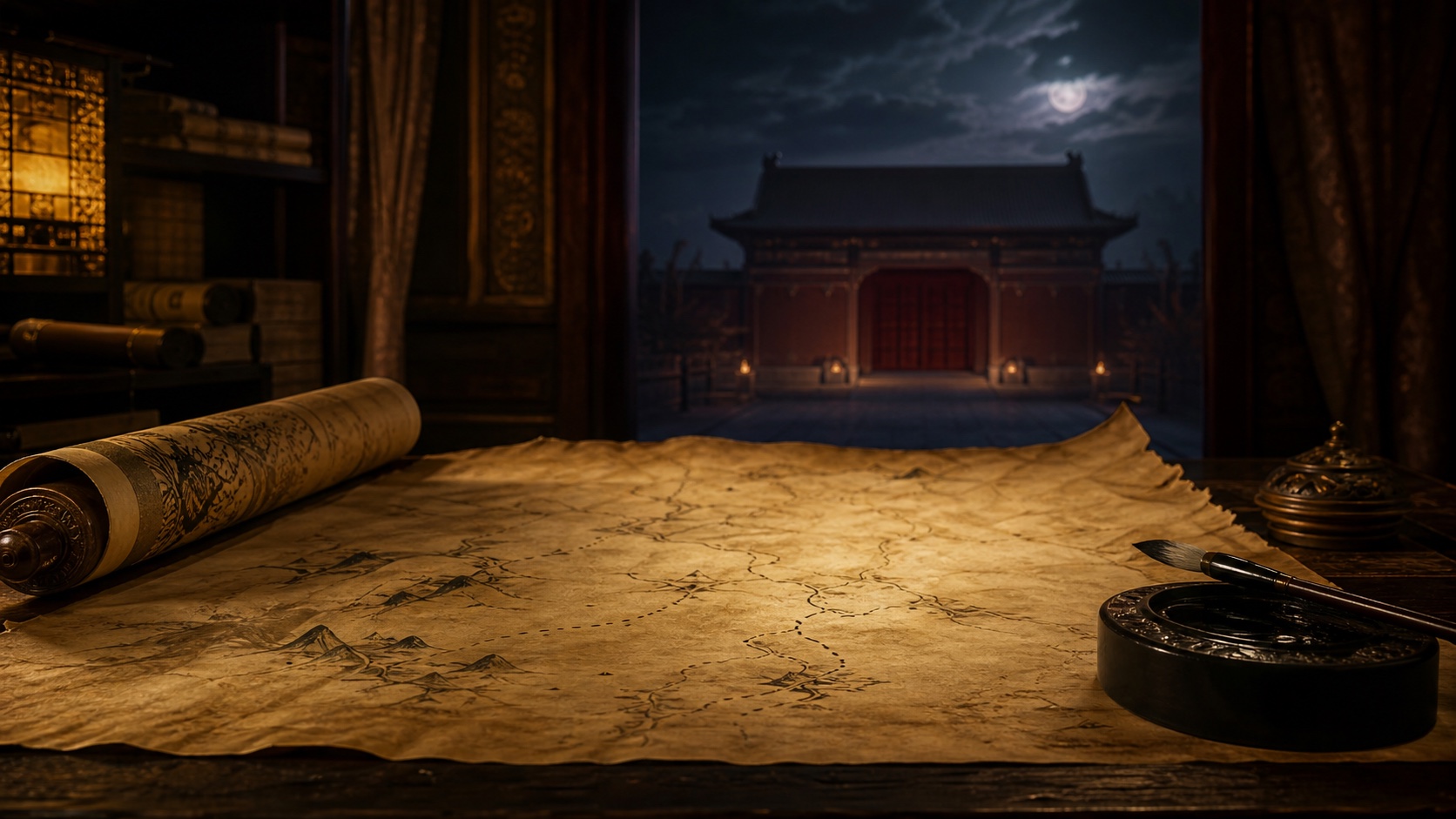
I should answer the simple question first.
No, Great Zhou is not a real Chinese dynasty. It borrows from real Chinese history, but it does not map neatly onto Han, Tang, or one hidden court you are supposed to decode. You can open the book without doing homework.
It is invented.
I know that can sound like a dodge. Sometimes “invented dynasty” makes readers wonder whether the history is thin, or whether the author wanted the mood of ancient China without the trouble of being exact. That is not what I mean by it.
For me, an imagined dynasty is a place close enough to history that the rules hurt, but not so fixed to the record that every woman in the book has to borrow a real woman’s grave.
That is the line I am usually trying to walk.
The bargain I make with history
When I reach for history, I usually reach for pressure before I reach for dates.
I mean a family needing a daughter placed well, and a ruler whose private liking can become public danger. I mean heirs, mourning rites, clan names, pregnancy, titles, and the old terrible question of who gets to be treated as a person once the court has found a use for her.
Those things are not decorative. They are the reason palace stories wound me in the first place.
The record is a different matter. Real dynasties come with known reigns, offices, laws, ceremonies, and actual people who lived under all of them. I read those histories with fascination, but also with a little fear. Real women are not empty silhouettes waiting for my plot. Even when the record is unfair to them, especially then, I feel a responsibility not to treat their names too casually.
If I put A-Jiao directly into the Han court, for instance, the story would immediately change. It would not be only A-Jiao’s story anymore. It would also be a claim about one real court, one real emperor, and one real woman whose afterlife in history is already complicated enough.
There are books that do that beautifully. I am grateful for them.
This one is not trying to be that kind of book.
Why Great Zhou exists
Great Zhou gives me a room I can control without pretending I found it in an archive.
In The Emperor’s Caged Bride, A-Jiao is forced to marry the Crown Prince after her cousin A-Shuo dies. The Cui clan still needs a daughter beside the heir, and A-Jiao is the daughter left standing. Her mother may grieve for her. Her aunt may try to soften the blow. None of that changes the use the family has already found for her.
That is where the book begins for me: not with a dynasty, but with a girl being moved into a marriage as if grief were a household vacancy.
Great Zhou lets the machinery around her feel solid. There is the Eastern Palace, the later imperial harem, the Kaiwu reign, the Cui clan’s power, and Weiyang Palace, which can be both the Empress’s residence and a locked room with a prettier name.
I like reign names because they sound so grand beside private misery. “The third year of Kaiwu in Great Zhou” has the clean surface of official time. It sounds like something that belongs at the top of a chronicle. But inside that date, A-Jiao is still a young woman learning that the palace can turn even memory into evidence.
That contrast is useful to me. The empire feels large. The calendar feels formal. A-Jiao’s life feels small beside both. But because Great Zhou is not a real court, I do not have to drag the reader away from her every few pages to prove the furniture.
I can stay in the room.
Titles, wounds, and the room’s grammar
The problem returns in a different shape in The Cloud Beside the Moon.
Yueying enters the Eastern Palace as Secondary Consort. She was once expected to be Crown Princess, so the lower title is not a small disappointment. It is a public rearrangement of her worth. Everyone in that household can read the change before anyone says a cruel word.
This is why I keep titles like Crown Princess, Secondary Consort, Liangdi, Empress, and Empress Dowager instead of smoothing them into something more familiar. A title in these books is not a decorative ribbon. It is the room’s grammar.
Yueying’s revenge grows out of that grammar. Her friendships do too. So does the cost of every bit of power she gains.
If I tied her to one documented reign, I would have to spend a great deal of the book answering the wrong questions. Was this rank used exactly this way? Would this ceremony have belonged to this household? Could this woman have held this title under this law?
Good questions, all of them. Just not the questions I want vibrating under Yueying’s hand when she decides whether to forgive, punish, laugh, or go cold.
I want the invented court to feel strict enough that her choices have teeth. I do not need it to be a court you can find in a year-by-year table.
Why I do not call it fantasy
I hesitate to call these books fantasy for one very practical reason: reader expectations.
If a reader picks up a fantasy novel, she may reasonably expect a secondary-world system, a mythology, supernatural rules, or at least the pleasure of seeing an invented world explained for its own sake. My books are not doing that. The palace is invented, yes, but the invention is there to sharpen human constraints, not to create wonder.
On the other hand, if I call them straight historical fiction, another reader may expect me to keep faith with one exact period. She may want the satisfaction of knowing that a robe, office, law, and political event can be traced to a specific dynasty.
That would be a fair expectation too.
So “imagined dynasty” is not only an aesthetic phrase. It is a warning label, in the gentlest sense. It tells you where the book is standing: beside history, borrowing its pressure, but not asking to be mistaken for the record.
Maybe this sounds like a small distinction. It is not small once a reader has paid for the book and brought her own hopes to it. A wrong label can make the right book feel like a betrayal.
The book with no neat dynasty
The Emperor’s Last Lie sits a little apart from Great Zhou, but the principle is the same.
Ye Changning is pulled back into the imperial harem after her family’s fall. Around her are substitutes, staged deaths, false pregnancies, old witnesses, and women who have survived by becoming useful in ways no one should have asked of them. The story has the shape of a harem mystery, but I never wanted readers trying to match its rebellion to a real one.
That kind of guessing would lead away from Changning.
Her question is more intimate: if the person who hurt you also protected you, and if the truth arrives after the life it might have saved, what are you supposed to do with the years that are left?
An invented court gives that grief some privacy. It lets Li Chengmu be Li Chengmu, not a shadow placed over a documented ruler. It lets Changning be judged by the wound of her own story.
Historically true is not historically accurate
This is the phrase I keep coming back to, though I know it has awkward corners.
Historically accurate is the checkable promise: this date, this title, this ceremony, this city, this law.
Historically true is harder to footnote. It means the story understands how power behaves. It knows that a promotion can be a threat, that a marriage can be a transaction wrapped in silk, that the inner palace is never separate from the outer court no matter how beautiful the walls are.
When I sit down to write these books, I am usually not chasing a perfect reconstruction. I am chasing smaller, more dangerous moments: the wrong name on a wedding night; a rank that lowers a woman before she has spoken; an Empress in a palace that technically belongs to her, still unable to leave.
Those moments do not need a real dynasty in order to be true.
They need the palace to behave honestly.
How to read one of these worlds
I wrote more practical guidance in A Beginner’s Guide to Chinese Palace Angst, so I will not repeat all of it here.
The shortest version is this: read the room before you read the dynasty.
Notice who sits, who waits, who controls the door, and which title makes everyone else adjust their voice. The names of the ranks will settle as you go. If one trips you up, keep the Palace Titles Guide open.
You do not have to become a historian before you are allowed to feel the story.
Why I keep choosing this
I keep choosing imagined dynasties because they let me stand close to the women: near the small humiliations, the title that changes the temperature of a room, the cost that remains after the official version of events has already moved on.
History often remembers who won. Palace fiction, at least the kind I write, keeps looking at who paid for it.
That is why Great Zhou exists, and why my other courts are inspired by Chinese history without settling inside one fixed dynasty. I am not trying to escape the past. I am trying to build a chamber where the past’s pressure can be felt clearly, without making my heroines borrow the names of women who already suffered enough.
If you want the books in order, the Reader’s Guide is there. If you only want to browse the shelf, start with the books.
But really, the thing I hope you carry from this page is simpler than any reading order:
The dynasty is invented. The cage is not.
Tia
A free story for new readers
The Empress He Could Not Keep — a complete short story
of empire, obsession, and the impossible return.
Yours when you join the reader list.