Why Weiyang Palace Is a Golden Cage
In The Emperor's Caged Bride, Weiyang Palace is rank, home, theater, and prison for A-Jiao.
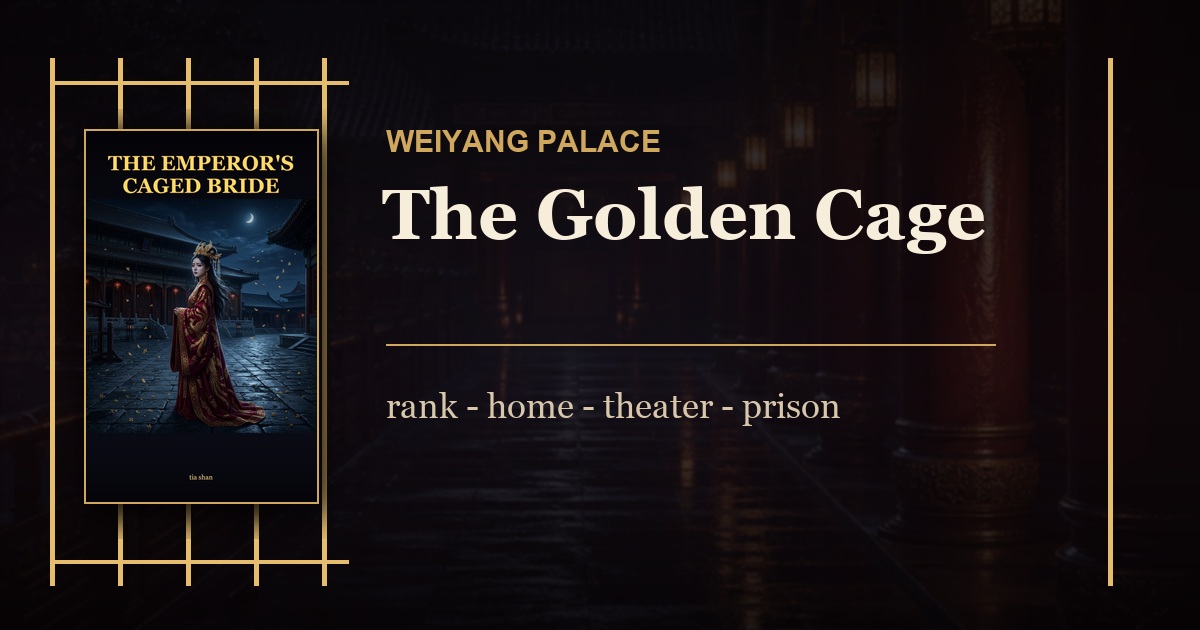
When I write a palace, I am rarely thinking of it as one thing. A palace is a house, an office, a stage, a weapon, a family archive, and sometimes a locked room with better curtains. Weiyang Palace in The Emperor’s Caged Bride is all of those at once. It is where A-Jiao becomes Empress. It is where other women come to bow. It is where the Cui family asks her to become useful, where the Emperor can appear or disappear as punishment, and where rank keeps glowing long after freedom has gone out. Light spoilers for the premise and mid-book confinement follow, but I will not discuss the final reveal.
The cruelest cage in palace fiction is often the one everyone else keeps calling an honor.
Weiyang Palace begins as proof of rank
Before Weiyang Palace belongs to A-Jiao, it belongs to her aunt: Empress Cui, the woman whose position seems almost unshakable. When A-Jiao first enters that space, the palace is not cozy or intimate. It is stately, severe, and ceremonial — the authority of the most honored woman in the empire made into a room.
That matters because A-Jiao has been raised to understand rank as protection. Her family tells her that marrying the Crown Prince will make her Empress. When the new Emperor ascends the throne, she moves from the Eastern Palace into Weiyang Palace and appears to have reached the highest female position possible. The name of the place becomes an answer to every objection she once had — the loss of Prince Ning, the man she had wanted to marry; the way she was sent in another woman’s place; her own private grief.
That is the first layer of the golden cage: the gold is real.
A-Jiao is not merely trapped in a pretty room. She is trapped in a room that comes with ritual authority. Weiyang Palace gives her attendants, ceremony, formal address, and the visible shape of power. It makes the sacrifice look meaningful.
For readers new to the hierarchy behind those rooms, my Palace Titles Guide explains why a title like Empress is not just a romantic label. It is political architecture.
It is also the Cui family’s last pillar
A-Jiao does not enter Weiyang Palace as a private woman. She enters as the daughter her clan still has left to spend.
Her aunt makes the logic plain: the Cui family once leaned on the reigning Empress; now it must lean on A-Jiao. That sentence turns Weiyang Palace into more than a residence. It becomes a load-bearing wall for an entire family. If A-Jiao falls, the Cui clan falls with her.
This is one reason I resist reading A-Jiao as simply passive. Every room she occupies is crowded with people who are not physically there: her mother, her aunt, her dead cousin A-Shuo, Prince Ning, the clan elders, the future children everyone expects her to produce. When she sits in Weiyang Palace, she sits under all of them.
That is why her choices can become morally grey without becoming easy to condemn. I wrote more about that in What Makes a Morally Grey Heroine Compelling?. A-Jiao’s damage often looks like yielding. But yielding, in this world, is an action with consequences.
And it must also be home
The cruelty of Weiyang Palace is not only that it gives A-Jiao a title. It is also that she has to live in it.
She does not get to leave at the end of the day. She does not get to be off-duty. The room where she receives the harem’s bows in the morning is the room where she sleeps at night. There is no kitchen she can wander into in old slippers, no corner she can claim as hers alone. Her clothes are chosen. Her food is tasted. Even her grief for A-Shuo has to be performed at the correct angle, so it does not look like resentment of her own marriage.
A house is a place that lets you put your shoes down. Weiyang Palace does not let her put her shoes down. That is the second layer of the cage: it is not only where she rules; it is where she lives — and both versions of her, Empress and girl, have to share the same walls without ever being allowed to be alone.
Weiyang Palace is a theater
The Empress’s palace is not private. It is where the harem comes to perform order.
Consorts arrive to pay respects. Servants watch which woman is favored. A pregnancy changes the emotional weather of the room. A smile is never only a smile, and the absence of the Emperor is never neutral. Even fragrance becomes performance. When A-Jiao tries to imitate A-Shuo by surrounding herself with osmanthus, the scent is not just a personal preference. It is a costume she hopes the Emperor will recognize.
That is the theater of Weiyang Palace: everyone knows the role, and everyone can see when the actress is bleeding through it.
The room asks A-Jiao to be the perfect Empress, the dutiful Cui daughter, the wife who does not flinch, the woman who can honor A-Shuo without being swallowed by her. None of those roles leaves much space for the girl who once wanted to run toward Prince Ning instead of toward the throne.
This is why the palace feels suffocating even before it becomes a literal prison. A-Jiao is watched before she is locked up. She is interpreted before she speaks.
The title remains after the power is gone
One of the most painful turns in The Emperor’s Caged Bride is that A-Jiao does not need to be stripped of her title for the cage to close.
After she confronts the Emperor, he confines her to Weiyang Palace. The command is brutally simple: she may not step beyond the palace gates for the rest of her life. But he does not erase the word Empress. That is the sharper punishment. The title stays. The room stays. The ceremony remains close enough to touch. The authority, however, has been hollowed out.
This is where Weiyang Palace becomes the most honest version of itself. The walls were always there. The gates were always there. The difference is that the story stops pretending rank and freedom are the same thing.
A-Jiao still holds the phoenix seal — the object that should make her command meaningful. Yet when she tries to use it to summon help, the palace has already learned that the Emperor’s displeasure outranks her seal. The symbol remains. The obedience does not.
That is a very palace kind of cruelty. Nobody has to say she is powerless. They simply stop answering.
Why the cage is golden
The phrase “golden cage” can become decorative if we are not careful. It can sound like a mood: pretty woman, beautiful room, sad music. But Weiyang Palace is not a metaphor pasted over the story. It is the mechanism of the story.
It is golden because A-Jiao really is Empress.
It is a cage because that rank was never designed to protect her whole self.
It protects the dynasty’s need for order. It protects the Cui family’s ambition. It protects the Emperor’s pride. It protects the illusion that a woman elevated to the highest seat must have been compensated for what she lost.
But it does not protect the girl who did not want to marry her dead cousin’s husband. It does not protect her love for Prince Ning. It does not protect her right to mourn A-Shuo as a cousin rather than imitate her as a predecessor. It does not protect her from the Emperor’s possessiveness, or from the way the court can turn one woman’s body into a solution for everyone else’s politics.
That is why Weiyang Palace hurts me as a setting. It is not a dungeon wearing silk. It is worse: a place where silk is part of the lock.
The palace as Tia Shan’s recurring question
Across my three palace tragedies, I keep returning to one question: what happens when the room that gives a woman status is also the room that consumes her?
For A-Jiao, the answer is Weiyang Palace. For Yueying in The Cloud Beside the Moon, the Eastern Palace and later the Empress’s seat become places where revenge can be organized but not cleansed. For Changning in The Emperor’s Last Lie, the harem turns identity itself into a locked room — name, resemblance, rank, and memory all become things other people try to assign.
In The Emperor’s Caged Bride, Weiyang Palace is the first answer I wrote. It begins as rank. It carries a family. It becomes home. It turns into theater. Then, when the story stops being polite, it reveals the prison that had been there all along.
The cage was always beautiful. That was how it survived being called a cage.
What to do next
If you want to enter Weiyang Palace with A-Jiao, start with The Emperor’s Caged Bride. If you need content notes first, the Reader’s Guide is the best doorway.
For more context before reading, try A Beginner’s Guide to Chinese Palace Angst or the companion essay on A-Shuo’s ghost, which explains the dead first wife whose absence shapes every room A-Jiao enters.
- Tia
A free story for new readers
The Empress He Could Not Keep — a complete short story
of empire, obsession, and the impossible return.
Yours when you join the reader list.