Cui Jiao Character Study — The Girl Beneath the Phoenix Crown
A character study of A-Jiao, the impulsive girl forced to become an Empress—and the strength hidden beneath her obedience.
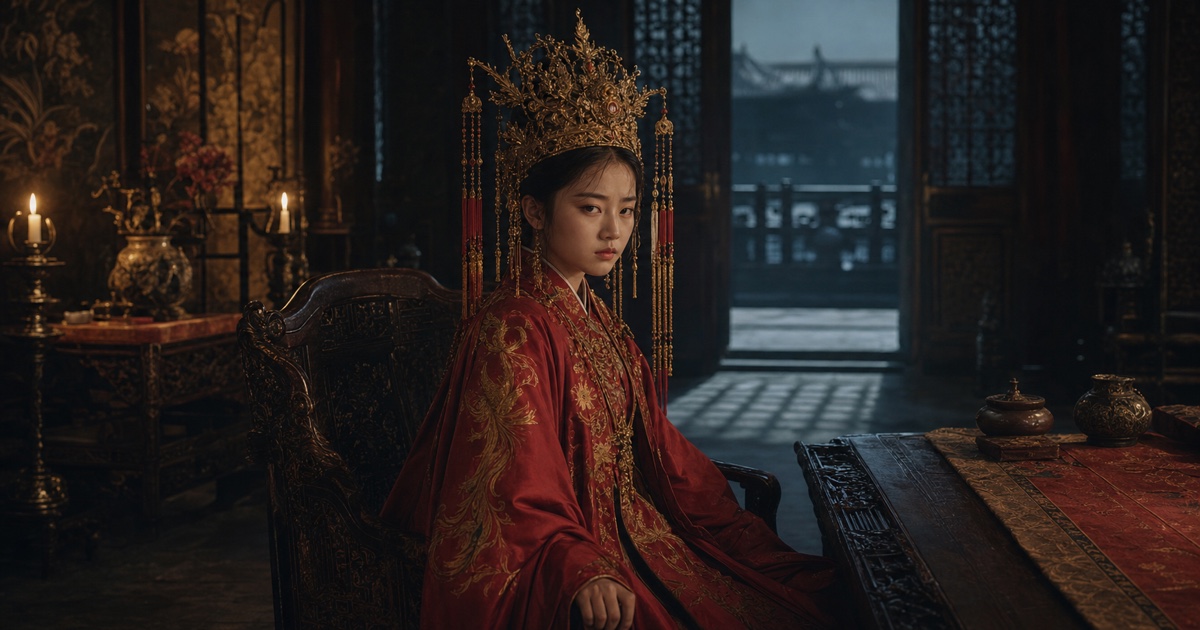
When I think of Cui Jiao, I do not first see the Empress seated in Weiyang Palace. I see a sixteen-year-old girl with her head buried under a quilt, shouting that she will not marry the Crown Prince. That first refusal matters to me because it is so young, so direct, and so completely ignored. By the time A-Jiao wears the phoenix crown, she has learned that saying no is not the same as possessing the power to make no endure. Her story in The Emperor’s Caged Bride is the story of what happens after a girl’s refusal fails: how she adapts, how she compromises, how she fights badly and bravely, and how everyone mistakes the shape of her captivity for weakness.
Light-to-medium spoilers follow for A-Jiao’s emotional arc and her confinement in Weiyang Palace. I do not discuss the novel’s final reveal or explain the ending.
Before the Empress, there is a girl who says no
A-Jiao is often remembered through what happens to her: she is ordered to marry her dead cousin’s husband, separated from Prince Ning, compared with A-Shuo, and eventually confined.
But the first thing she does in the novel is resist.
She cries. She argues. She asks why another Cui daughter cannot be chosen. She slips out to Prince Ning and tries, however clumsily, to discover whether any road remains open to them.
None of this is politically effective. That does not make it meaningless.
A-Jiao knows what she wants. She wants Prince Ning, not the Crown Prince. She understands that marrying A-Shuo’s widower is wrong in a way ceremony cannot make clean. The tragedy is that every institution around her has decided her will is the least important fact in the room.
Her mother does not persuade her. Her family does not ask her. They explain the arithmetic: A-Jiao is legitimate, marriageable, and still alive. Therefore, she is the Cui daughter who must go.
The phoenix crown is a family burden
The court calls the marriage an elevation. A-Jiao’s mother tells her she will one day become the most honored woman in the world. Her aunt, Empress Cui, teaches her to think of the phoenix seat as both protection and obligation.
But A-Jiao never wears the crown for herself alone.
The Cui clan is sitting beneath it with her.
That pressure changes her from an impulsive girl into a dutiful Crown Princess and then an Empress. She has been raised to believe that a legitimate daughter is a position the family can place where needed. Once her aunt dies, A-Jiao must become the pillar holding up the clan.
Calling her weak misses the scale of that burden. It also misses the trap inside it.
If A-Jiao rebels, she imagines the fall of her parents, cousins, and child. If she submits, the submission is praised as virtue. The palace offers no choice that harms only herself, then judges her for failing to choose freely.
I wrote about Weiyang Palace as a golden cage, but the phoenix crown works in much the same way. It gives A-Jiao visible authority while fastening invisible obligations around her head. The gold is real. So is the weight.
Imitating A-Shuo is labor, not emptiness
One of A-Jiao’s most painful transformations is her attempt to become more like A-Shuo.
She remembers the books A-Shuo read. She learns to make the rouge A-Shuo used. She brings osmanthus into her rooms because A-Shuo loved its fragrance. She studies the dead woman’s expressions, trying to cry and smile in ways her husband might recognize.
From the outside, this can look like passivity or a lack of self. I see something more difficult.
A-Jiao is working.
She is learning the emotional language of a marriage she never chose because favor is no longer private. Imperial attention affects her safety, her family, and the child everyone demands from her. Becoming A-Shuo is self-erasure, but it is also political labor performed with very few tools.
The labor cannot succeed. A living woman cannot defeat a dead one preserved in memory. A-Jiao assumes the Emperor wants a better imitation, so she keeps sanding away pieces of herself.
That is why A-Shuo’s ghost matters so much. A-Shuo is not simply a romantic rival. She is the approved version of a Cui daughter—the woman A-Jiao is asked to reproduce without ever being allowed to become.
Tears are not the opposite of strength
A-Jiao cries often. She is frightened of the Emperor. She misreads him. She can be childish, jealous, impulsive, and painfully easy to hurt.
None of those qualities cancels her strength.
We often treat emotional control as proof of power. The woman who never cries is formidable; the woman whose fear shows is weak. Palace life encourages that judgment because every visible feeling can become leverage.
But A-Jiao’s tears do not stop her from acting.
She walks through a storm while heavily pregnant to plead for Prince Ning’s life. She takes the blame for their old bond to protect him. Later, when the Cui clan falls, she enters the imperial hall carrying a sword and demands an answer.
These are not the actions of a woman without will.
They are the actions of someone whose resistance has been repeatedly punished, redirected, and made desperate.
Her sharpest weapon is the truth he cannot bear
The moment that reveals A-Jiao most clearly is not a graceful political victory. It is ugly, intimate, and dangerous.
When the Emperor uses Prince Ning, her family, and even A-Miao as threats, A-Jiao reaches for the one weapon still available to her: she calls him brother-in-law.
The word strips the marriage of its imperial costume. It restores the fact everyone has buried: he was A-Shuo’s husband first, and A-Jiao was sent into her cousin’s place. She makes his desire sound as disordered as the marriage has always felt to her.
She knows the word will provoke violence. She says it anyway.
A-Jiao cannot win the confrontation. The Emperor controls the guards, decrees, gates, and lives of those she loves. But for one moment, she controls the meaning of the room. She refuses to let power rename what happened to her.
That refusal is one of the fiercest things she does.
The girl beneath the crown never fully disappears
By the time Weiyang Palace becomes a literal prison, A-Jiao is more politically alert, more calculating, and less trusting. She understands that a title can remain while power vanishes. She plans for her son’s future because motherhood is the last arena in which she can still force part of the world into a shape of her choosing.
Yet the impulsive girl from the first chapter is not gone.
She is there when A-Jiao defies confinement to visit the dying Consort Dowager Xu, and when she uses the phoenix seal after the palace has decided not to obey it. She still acts as though being Empress must mean she can protect someone.
That persistence is what moves me most.
Yueying in The Cloud Beside the Moon turns grief into a long campaign. Changning in The Emperor’s Last Lie survives by disappearing and later by questioning every lie placed before her. A-Jiao has neither woman’s room to maneuver. Her resistance is smaller, messier, and easier to dismiss. It happens inside obedience, inside motherhood, inside tears, inside moments when she is already losing.
But it happens.
She was not weak. She was trapped.
I do not want to make A-Jiao perfect in order to defend her.
She makes choices that hurt people. She hides inside duty. She waits too long to understand some truths and acts too quickly on others. The pressure surrounding her explains those choices; it does not wash them clean.
But weakness is not the right word.
A-Jiao is the force around which every relationship bends: the Cui clan’s hopes, Prince Ning’s exile, the Emperor’s jealousy, A-Shuo’s memory, Wang’er’s future, and the silence inside Weiyang Palace.
The phoenix crown does not prove that she won. It proves how much weight the world found convenient to place on one young woman’s head.
Underneath it, A-Jiao remains frightened, stubborn, loving, shortsighted, proud, and alive to the wrongness of what has been done to her. She does not always resist wisely. She does not always resist in time.
Still, she resists.
That is the girl beneath the phoenix crown.
What to Do Next
If you want to meet A-Jiao in the novel, start with The Emperor’s Caged Bride, available on Kindle and Kindle Unlimited.
If you prefer content notes first, begin with the Reader’s Guide. Then read Why Weiyang Palace Is a Golden Cage for the setting around A-Jiao, or The Osmanthus Wine, the Swing, and the Jade Pendant for the memory of who she was before the crown.
And when A-Jiao cries, do not mistake the tears for surrender.
— Tia
A free story for new readers
The Empress He Could Not Keep — a complete short story
of empire, obsession, and the impossible return.
Yours when you join the reader list.