The Osmanthus Wine, the Swing, and the Jade Pendant: Three Objects That Hold Three Books
How three small objects carry the emotional weight of Tia Shan's three palace tragedies: wine, a swing, and a jade pendant.
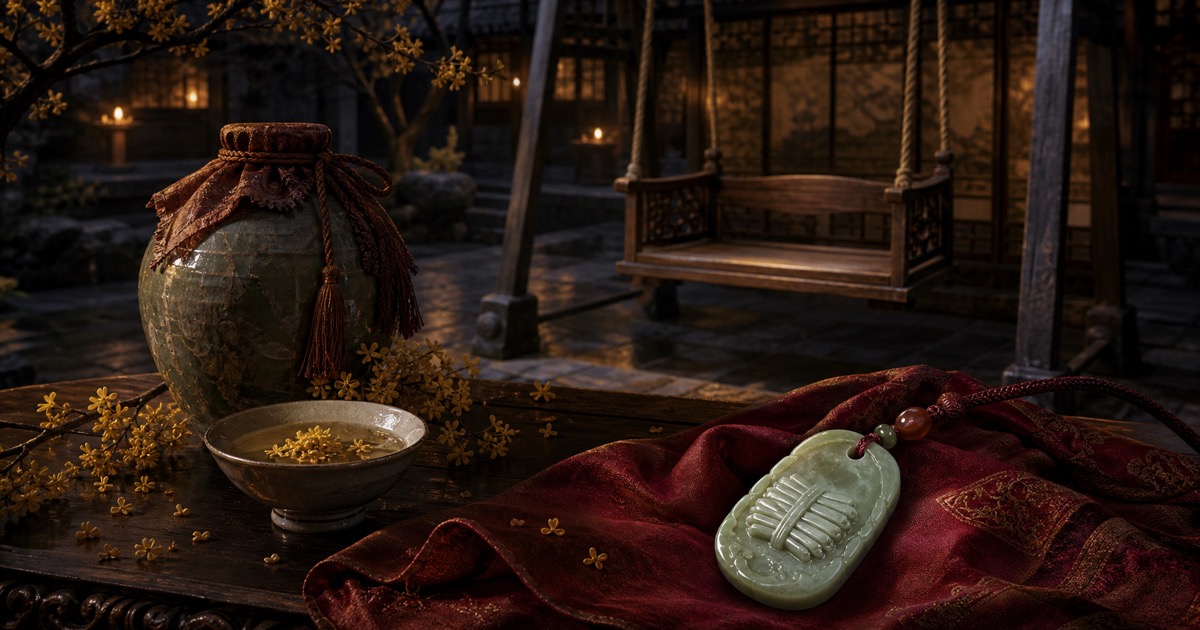
I have a weakness for objects that look too small to hold the grief they are carrying. A palace has obvious symbols: crowns, seals, gates, veils, thrones. Those are designed to announce power. But the objects I return to most often are quieter. A jar of wine. A swing. A jade pendant with an odd carving. They do not rule anything. They cannot save anyone. Yet each one remembers a woman before the palace found its final use for her. In that sense, these three objects are not decorations inside the books. They are the books, folded down until they fit in one hand.
Light spoilers follow for the emotional arcs of The Emperor’s Caged Bride, The Cloud Beside the Moon, and The Emperor’s Last Lie. I avoid the final reveal of The Emperor’s Last Lie.
Why objects matter in palace tragedy
Palace fiction is full of beautiful things, but beauty is not safety. That is one reason I wrote the broader glossary of palace objects, places, and symbols: a reader can track a story through what people touch, carry, or refuse to let go.
Objects matter because the palace makes direct speech dangerous. A woman cannot always say, I am afraid. She cannot always say, I wanted a different life. So the feeling goes elsewhere: scent, wood, jade, silk, paper, ash.
Book 1: Osmanthus wine
In The Emperor’s Caged Bride, the osmanthus wine belongs first to a night before the trap closes.
A-Jiao has just learned that she must marry the Crown Prince, her dead cousin A-Shuo’s widower. The man she loves is Prince Ning. So when Prince Ning takes her to Qingliang Hall and digs up the wine she buried three years earlier, the jar becomes more than a youthful secret.
It holds the last evening when four people could still sit under the moon as themselves.
A-Jiao, Prince Ning, A-Shuo, and the Crown Prince once drank there together. Before A-Shuo became a ghost in every marriage. Before A-Jiao became the second Crown Princess. Before Prince Ning became the forbidden road. Before the Crown Prince’s silence hardened into imperial right.
The wine hurts because it was meant for later.
To bury wine is to believe in return. It says: one day we will open this, and the people who made this promise will still be here. But when the jar is opened, the future has already betrayed the promise. A-Jiao is going to marry the wrong man. Prince Ning can see it and cannot stop it. The moonlit hall becomes a farewell disguised as one last childish outing.
That is why the osmanthus matters more than perfume. Later, A-Jiao uses osmanthus scent and rouge while trying to imitate A-Shuo, because A-Shuo loved it. The same flower that once belonged to freedom becomes part of A-Jiao’s self-erasure. First it remembers the girl who could still ride out of the capital. Then it remembers the dead woman A-Jiao must become to survive her husband.
The object does not change. The world around it does.
If you read A-Shuo’s ghost as the absent woman who fills the room, the osmanthus wine is the room before she became absent. It is the sweetness no one protected in time.
Book 2: The swing
The swing in The Cloud Beside the Moon is less ceremonial than the wine. It appears in Yueying’s courtyard, ordinary and almost domestic, which is exactly why it wounds me.
Yueying’s story begins with humiliation. She enters the Eastern Palace as Secondary Consort, not Crown Princess, and her wedding night becomes the wound that shapes the rest of her life. The palace teaches her that a woman’s body, rank, pregnancy, illness, and favor can all become public evidence.
And then there is the swing.
Hu Mianmian pushes Yueying on it. For a moment, the courtyard is allowed to sound like two young women instead of two ranked consorts inside the heir’s household. Mianmian is lovesick, dramatic, tender, foolish, and more sincere than the palace deserves. Yueying teases her, worries for her, underestimates her pain, and loves her in the impatient way of someone who has not yet learned that softness can be fatal.
The swing keeps girlhood moving after the palace has already begun to eat it.
That motion matters. A swing is not escape. It rises, falls, rises, falls, always tethered to the same point. It gives the body air without releasing it. Yueying can laugh, manage her courtyard, hold her daughter, and be loved by Mianmian. But the ropes are still tied to the same structure.
After Mianmian, the swing cannot stay innocent. It becomes one of the objects by which Yueying remembers that the women around her were not born as rivals, instruments, or casualties. They were girls first. Wen Shuer later sees Yueying and Mianmian on the swing and longs to join them because it reminds her of her own sister. The swing is no longer only Mianmian’s brightness. It is the ordinary female life the palace keeps interrupting.
I wrote more about Mianmian’s promise in The Meaning of the Moon and Cloud, but the swing is the earlier version of that promise. Before she becomes the cloud beside the moon, Mianmian is still a girl pushing her friend higher.
That is the tragedy. The swing remembers laughter because the rest of the book has to remember what was lost.
Book 3: The jade pendant
The jade pendant in The Emperor’s Last Lie is the most private of the three objects.
At first, Changning treats it almost carelessly. Li Chengmu leaves it behind, and she tosses it toward Yinyuan as if it might count as a reward. Yinyuan understands the palace meaning faster than Changning wants to: a personal token from the Emperor is favor made touchable.
But the pendant is not important because it proves favor. It is important because its carving does not belong to the usual language of palace favor.
Not dragons. Not phoenixes. Firewood.
The carving points to “Choumou” from the Book of Odes: bundled firewood, stars in the sky, the wonder of meeting one’s beloved on a wedding night. In another kind of story, that would be simple romance. A young man gives a wedding blessing. The poem means what it says.
In this book, the blessing is attached to the wrong life.
Li Chengmu gives the pendant for Changning’s first marriage to Crown Prince Li Chengyu. The gift is outwardly proper, even generous. Underneath it sits everything that cannot be spoken: childhood love, political impossibility, a wedding chamber he will not enter, and a blessing he has no right to want for himself.
Years later, after rebellion, death, temple exile, and return to the palace, the pendant comes back into Changning’s hands with a different weight. It has survived the life that did not. Li Chengmu carries it against his body for years. Changning once returned it to him with the bitterness of a blessing scattered beyond repair. When she recognizes the carving, the pendant becomes an archive of all the years they missed each other.
That is why I love that the carving is firewood. Firewood is ordinary. It belongs to heat, cooking smoke, rooms where people live because they are people, not because history has assigned them a title. It suggests a household, not a court.
And an ordinary household is exactly what Changning and Li Chengmu never get.
In Three Books, Three Palaces, I described The Emperor’s Last Lie as a love story told in reverse. The jade pendant is that structure in miniature: wedding blessing, relic, misunderstanding, and emblem of a life almost understood too late.
Three objects, three wrong arrivals
Put the three objects beside one another and a pattern appears.
The osmanthus wine arrives too early. It is made when A-Jiao still believes some part of the future can be saved for later.
The swing exists in the fragile middle. It lets friendship and girlhood flicker inside a palace already arranging the terms of loss.
The jade pendant is understood too late. Its meaning has been present all along, but the characters can only read it after time has done its worst.
That is how these books use objects: not as Easter eggs, but as emotional clocks. Wine ferments. A swing repeats. Jade endures. One sweetens in the dark, one moves without leaving, one survives long enough to accuse the living.
If you are new to the books, start with the spoiler-light map at Three Books, Three Palaces or choose directly from the Books page. If you want content notes first, the Reader’s Guide is there for you.
And if you are already inside the inner palace, pay attention to the small things.
The throne will tell you who has power.
The wine, the swing, and the jade will tell you who was alive before power found them.
Tia
A free story for new readers
The Empress He Could Not Keep — a complete short story
of empire, obsession, and the impossible return.
Yours when you join the reader list.