The Meaning of the Moon and Cloud in The Cloud Beside the Moon
A spoiler-light reading of the moon, the cloud, Mianmian's promise, and Yueying's name in The Cloud Beside the Moon.
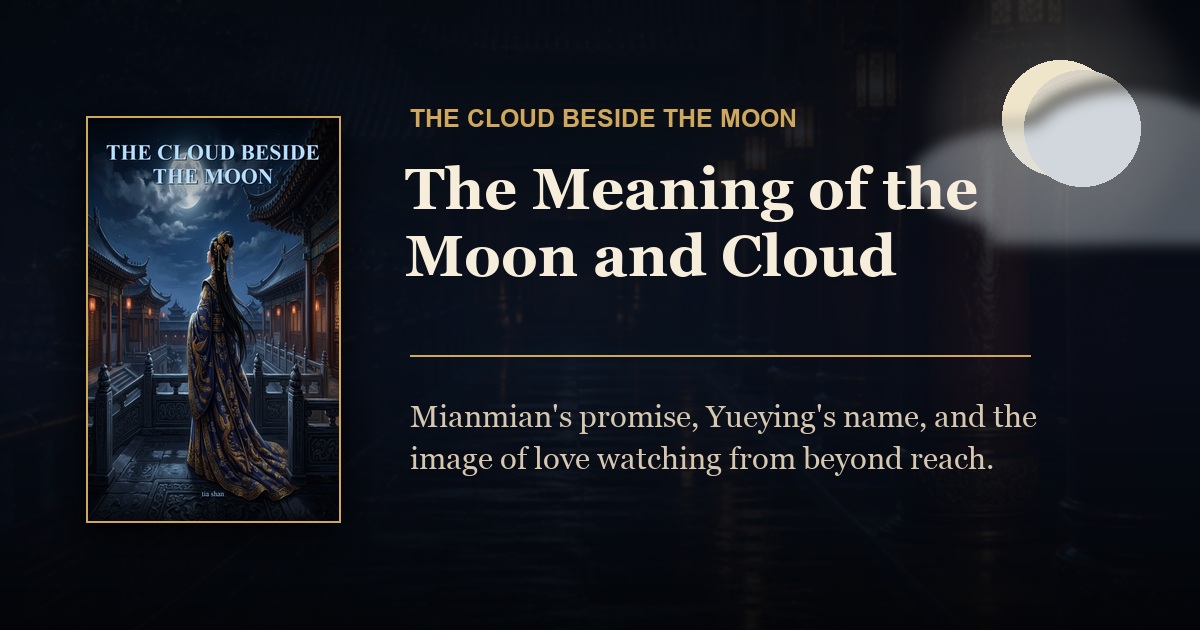
Some titles arrive after the plot. This one arrived from the wound. When I think of The Cloud Beside the Moon, I do not first think of the Emperor, the revenge, or even the throne Yueying eventually learns how to hold. I think of one girl on a sickbed, feverish and too young, trying to leave her friend with a promise beautiful enough to survive death. The moon and the cloud are not decorative images in this book. They are a private language between women: a way to speak about love, distance, witness, and the ache of being unable to save the person beside you.
Light-to-medium spoilers follow for The Cloud Beside the Moon, especially the meaning of the title and the emotional arc behind it.
The title begins with Mianmian
Hu Mianmian could easily have been reduced to a familiar palace type: the lovesick side consort, too sincere for the inner court, too dazzled by a man who cannot love her properly. But that is not how I see her.
Mianmian matters because her feeling is real.
She is bright, earnest, impulsive, almost painfully transparent. She loves in a place where transparency is dangerous. The Eastern Palace teaches women to measure words, rank, glances, favors, medicine bowls, and closed doors. Mianmian has no talent for that kind of guarded survival. She wants to believe friendship is friendship, love is love, and a woman can admit longing without someone turning that longing into a knife.
That innocence is not foolishness in the simple sense. It is a form of exposure.
When Mianmian dies, she does not curse the palace. She does not use her last breath to make a political accusation. She speaks to Yueying, the friend she is leaving behind, and imagines herself going upward. She will become the cloud beside the moon. She will watch Yueying live happily for a whole lifetime.
That promise is the title’s heart.
It is tender because Mianmian is still thinking of Yueying’s future. It is devastating because the reader already understands how little power a dying girl has to guarantee happiness in a palace. And it is morally important because Mianmian’s last image shifts the center of the book away from the man everyone is supposed to orbit.
The Crown Prince may be the object of Mianmian’s romantic longing. But in the end, her final imagined place is beside Yueying.
Yueying already belongs to the moon
Yueying’s name carries the moon before Mianmian ever speaks that promise.
That matters because Yueying is not a warm-sun heroine. She is proud, cold when she must be, funny in a blade-edged way, and almost allergic to sentimental surrender. Her inner life often has the temperature of moonlight: clear, watchful, beautiful, and not easily touched.
The moon appears first as blessing. When Yueying names her daughter Chan’er, she reaches for the old idea of two people sharing the moon across distance. It is a mother’s wish: may this child live a whole life, may she be loved, may separation never make beauty unreachable.
But the book keeps darkening that wish.
After Mianmian dies, every moon becomes a reminder. Yueying does not simply remember her friend at night. She is watched by the promise. The title image turns grief into atmosphere. Mianmian is gone, yet the world refuses to empty itself of her. Every bright patch in the dark can become her face.
This is why the moon in the novel is not only romantic. It is not the moon of lovers standing under the same sky and finding comfort. It is the moon of someone who must keep living after a friend has become unreachable.
For a broader view of how these books treat palace life as pressure rather than ornament, you can read A Beginner’s Guide to Chinese Palace Angst. Yueying’s story is one of the coldest examples: the palace does not merely separate women. It teaches them to survive by becoming difficult to save.
The cloud is not lesser than the moon
Cloud and moon can sound like a hierarchy: the moon shines, the cloud follows. But Mianmian’s promise does not feel lesser to me.
A cloud can cover the moon, soften it, accompany it, or make its light visible by contrast. A cloud moves, changes shape, and never quite stays where a person wants it to stay. That is exactly why the image hurts. Mianmian is not promising to become a fixed monument. She is promising presence without possession.
She cannot remain in Yueying’s room. She cannot raise Chan’er, laugh on the swing, or interrupt Yueying’s bitterness with some ridiculous comment about the Crown Prince. What she can become is witness.
And witness is one of the deepest forms of love in these books.
In The Emperor’s Caged Bride, A-Jiao suffers partly because she is seen wrongly. In The Emperor’s Last Lie, Changning suffers because too many people hide the truth from her in the name of protection. Yueying’s wound is different. She is seen by Mianmian before she is seen by power. Mianmian knows her as a friend, not as Secondary Consort, rival, wife, mother, or Empress.
That kind of seeing cannot protect Yueying from the palace. But it gives her something the palace cannot fully rewrite.
This is also why Mianmian’s death becomes more than motive. It becomes a standard by which Yueying judges the living.
After Mianmian, Yueying’s revenge is never only strategy. It is grief trying to become justice. It is also guilt. She did not understand Mianmian’s love quickly enough. She could not save her. Once the cloud has taken its place beside the moon, Yueying must live under that unfinished promise.
The moonlit almost-love
Years later, the moon returns in one of the book’s quietest and most dangerous scenes.
Yueying is no longer the girl who first entered the Eastern Palace. She has gained rank, authority, children, enemies, and losses. Under moonlight, she looks at the Crown Prince with a kind of clarity she has avoided for years. For one instant, she sees the man he might have been in another life. She understands, perhaps for the first time, what Mianmian felt when love seemed large enough to make suffering bearable.
That is the closest the book comes to a conventional romantic turn.
And Yueying refuses it.
Her refusal is not simple hatred. It is self-preservation. The man standing in moonlight is also the man who broke the beginning of her married life. To love him cleanly would require her to set down the humiliation that shaped her. It would require the palace to become a softer story than it has been. Yueying cannot make herself pay that price.
So the moonlit scene becomes the book’s central “almost.”
Almost love. Almost forgiveness. Almost a life in which tenderness arrives before too much has been destroyed.
That is why The Cloud Beside the Moon is not best understood as a romance with tragic decoration. It is a tragedy where romance appears as one of the possible lives the characters missed. I wrote more about that larger pattern in Why Palace Romance Needs Tragedy, but Yueying’s case may be the sharpest: by the time love becomes imaginable, dignity has already become nonnegotiable.
What the image leaves behind
By the end of the novel, Yueying has won more than the girl in the first chapter could have imagined. She has rank. She has authority. She has learned the household language of power. She has made enemies afraid of her.
But winning does not return Mianmian.
It does not return the young women who might have been friends without the palace teaching them to compete for warmth. It does not return the version of Yueying who could have loved without feeling that love was another form of defeat.
The moon and cloud therefore become the book’s answer to a cruel question: what remains when revenge cannot restore the dead?
Not innocence. Not absolution. Not a happy ending pasted over harm.
What remains is witness.
Mianmian watches from beyond reach. Yueying carries the moon inside her own name. The reader is asked to stand with both of them: the girl who loved too brightly and the woman who lived too long with the cost of that brightness.
This is why the title still hurts me. The cloud is not a decorative softness beside a beautiful moon. It is the shape grief takes when love has nowhere else to go.
What to do next
If you want to read the novel behind this image, start with The Cloud Beside the Moon. It is available on Kindle and Kindle Unlimited.
If you need content notes first, begin with the Reader’s Guide. If you want to understand how this book fits beside the other two palace tragedies, read Three Books, Three Palaces.
And when you open The Cloud Beside the Moon, watch the night scenes carefully.
The moon is never only scenery.
- Tia
A free story for new readers
The Empress He Could Not Keep — a complete short story
of empire, obsession, and the impossible return.
Yours when you join the reader list.