The Emperor in The Emperor's Caged Bride — Love, Possession, and Ruin
Why the Emperor's love cannot redeem his violence—and how Prince Ning reveals the road A-Jiao was never allowed to choose.
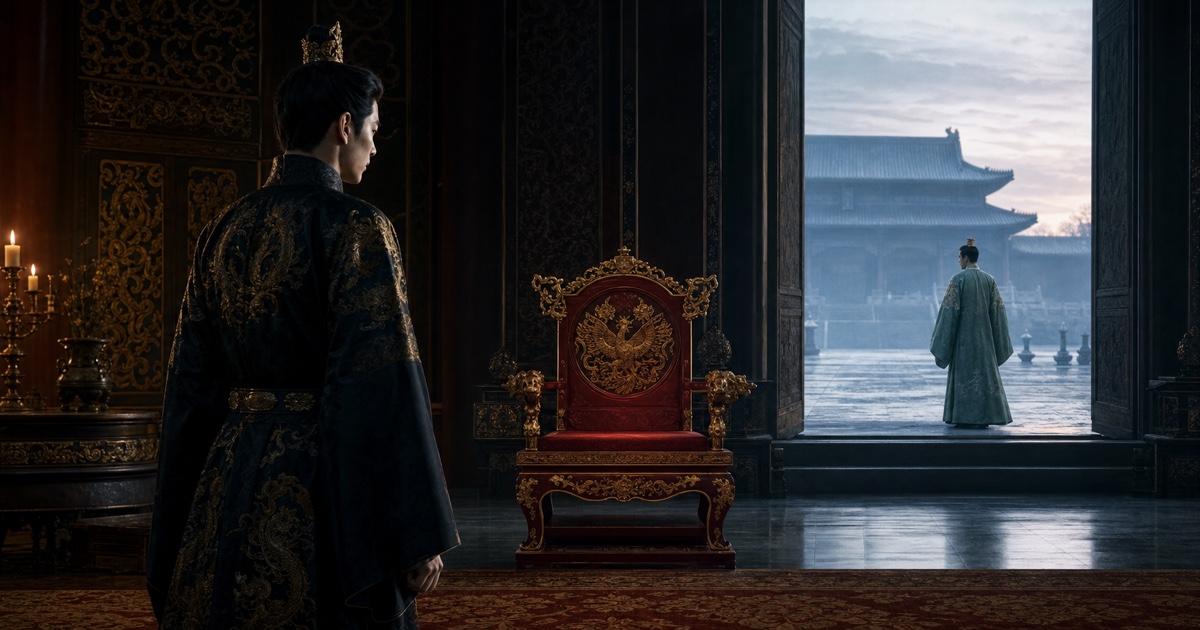
When I wrote the Emperor in The Emperor’s Caged Bride, I did not want the final discovery of his love to turn backward through the novel and wash every wound clean. Love is not a verdict of innocence. A man can feel deeply and still make the person he loves afraid of him. He can protect her family in one moment and use that same family as a threat in the next. He can spend years unable to speak the truth, then discover that the truth has arrived too late to become tenderness. The Emperor’s tragedy is not that he never loved A-Jiao. It is that the only language he trusted for love was possession—and possession gave him the power to ruin what he could not bear to lose.
Major spoiler warning: This article discusses the novel’s final emotional reveal, A-Jiao’s confinement, and the fates of both central men. Read The Emperor’s Caged Bride first if you want the ending unspoiled.
Love is not a moral achievement
The Emperor’s deepest attachment was never to A-Shuo. It was to A-Jiao.
That revelation changes many earlier scenes. His interest in A-Jiao’s childhood name, his jealousy of Prince Ning, and his demand to know whether she has ever liked him become legible at once. Even his A-Shuo comparisons look less like simple mourning and more like a man hiding desire behind a safer explanation.
But recontextualization is not absolution.
The Emperor’s feeling may be sincere. His conduct is still his conduct. He strangles A-Jiao, strikes her, humiliates her, threatens Prince Ning and Prince Ning’s child, threatens to bring A-Miao into the harem, and confines A-Jiao inside Weiyang Palace for life.
Jealousy rather than indifference makes the story more tragic, not the actions less violent.
He turns emotion into jurisdiction
The Emperor does not merely love as a husband. He loves as the person who controls decrees, guards, appointments, exile, and death.
That difference is the center of his character.
When he looks at Prince Ning, he does not see another man who once loved A-Jiao. He sees someone who has trespassed against imperial property: my empress. His jealousy becomes a corruption case, a political purge, and a lifelong banishment. A private wound is executed through the machinery of the state.
This is possession in its most dangerous form. The Emperor does not need A-Jiao to choose him. He needs the world to make every other choice impossible.
He keeps Prince Ning alive because separation allows two people to suffer longer. He watches A-Jiao and turns the lives of people she loves into levers attached to her obedience.
In another man’s hands, jealousy might become an argument or a departure. In an Emperor’s hands, it becomes policy.
Even his care arrives as coercion
The Emperor is not incapable of care. That is what makes him more unsettling than a flat tyrant.
He spares Prince Ning when A-Jiao’s life hangs in the balance. He prevents the Cui clan’s fall from becoming a massacre and never strips A-Jiao of her title. After her death, he raises no new Empress and chooses burial beside her.
Those actions tell us something real about his attachment.
Yet almost every act of care is tangled with control. During A-Jiao’s dangerous childbirth, he forces her to keep living by threatening Prince Ning’s life. When she takes poison, he reaches again for the same threat. Even at the edge of losing her, he cannot simply say, live because you are loved. He says, in effect, live because I can still hurt someone you love.
That is his emotional failure: he uses fear to produce the response affection could not secure.
By the time he accepts the name brother-in-law, admits that he schemed to marry her, and offers to bring Prince Ning back, the truth has lost its power to repair. He is finally willing to give A-Jiao a choice only when she is no longer able to take it.
The truth arrives after the damage
Years later, dying at forty-two, he mistakes A-Miao for A-Jiao and speaks of another life: he will find her first, marry her first, and ask whether she might like him a little. There is no throne in that wish. No Cui clan, dead first wife, or younger brother standing between them. He imagines an ordinary sequence in which love is spoken before power distorts it.
But longing for a better life is not the same as repairing this one.
Redemption would require recognition, accountability, and changed behavior while A-Jiao is alive enough to experience the change. The Emperor offers recognition only at the end. His remorse cannot return her years, restore her freedom, or teach her that his touch is safe.
His love explains the ruin. It does not redeem it.
Prince Ning: the road A-Jiao did not take
Prince Ning matters because he shows us a form of love that exists before ownership.
With him, A-Jiao has memory and ease. She knows his moods at a glance; he knows the girl before the phoenix crown. Their night at Qingliang Hall holds the last version of her life in which marriage might still have been personal.
He does not need A-Jiao to resemble A-Shuo or require rank in order to see her.
That makes him the structural opposite of the Emperor. The Emperor keeps pulling A-Jiao closer until closeness becomes imprisonment. Prince Ning responds to losing her by creating distance.
But distance has its own wound.
The gentler man still yields
Prince Ning asks A-Jiao whether she has ever had a mind of her own. It is a painful question because he understands her obedience and still treats it as if it were simply a personal failure.
Then he tells her that after that night she is no longer the Cui Jiao he knew. She is the Crown Princess, and she must not come looking for him again.
His withdrawal may be self-protection or the only honorable boundary left once she is promised to his brother. But to A-Jiao, the person who knew her before the palace has also begun addressing the role instead of the girl.
Later, when the Emperor arranges Prince Ning’s marriage, Prince Ning accepts without hesitation: everything will be as Father Emperor commands. The parallel is deliberate. He once accused A-Jiao of obeying her family, then obeys the imperial father when the order reaches him.
This does not make him equivalent to the Emperor. He does not assault A-Jiao, weaponize the state against her, or demand her body. He builds a life with his wife and protects his family when he meets A-Jiao again. His restraint is real.
It is simply not rescue.
The road not taken was never fully open
It is tempting to imagine Prince Ning as the happy ending stolen from A-Jiao. In a kinder world, perhaps he is.
But Prince Ning is still an imperial son and A-Jiao a Cui daughter. Their marriage can be suggested, reassigned, or forbidden by people with more power. The architecture that forces her toward the Crown Prince also teaches Prince Ning when to step back.
He represents a healthier possibility, not a guaranteed escape.
The contrast between the brothers is not that one loves and the other does not. Both love her. The difference is what they do when love meets a boundary.
Prince Ning accepts the boundary, even when acceptance becomes abandonment.
The Emperor destroys the boundary, even when destruction becomes captivity.
One lets A-Jiao go before she is ready. The other refuses to let her go at all.
What A-Jiao actually deserved
A-Jiao deserved more than a choice between the man who relinquished her and the man who possessed her. She deserved the right to decide whether either man would become her husband. She deserved to remain Cui Jiao after the court began calling her Crown Princess. She deserved love that did not turn her family, child, title, and freedom into bargaining pieces.
The Emperor’s final truth is emotionally powerful because it exposes how much was wasted. He loved her. He also made himself the person from whom she needed protection.
That is the ruin at the center of the novel.
He did not love A-Jiao too little.
He loved her through power, pride, jealousy, and silence—until love became indistinguishable from the cage.
What to Do Next
For A-Jiao’s side of this marriage, read Cui Jiao — The Girl Beneath the Phoenix Crown. For the dead woman both men stand in relation to, continue with A-Shuo’s Ghost.
If you have not read the novel yet, The Emperor’s Caged Bride is available on Kindle and Kindle Unlimited. The Reader’s Guide has content notes before you enter Weiyang Palace.
And if the ending makes you want to forgive him, pause first and ask a harder question:
Did his love ever make A-Jiao safer?
— Tia
A free story for new readers
The Empress He Could Not Keep — a complete short story
of empire, obsession, and the impossible return.
Yours when you join the reader list.