The Real Costumes Behind My Imagined Dynasty
How Han, Tang, and Northern Wei costume references shaped the visual world of Tia Shan's three imagined-dynasty palace tragedies.
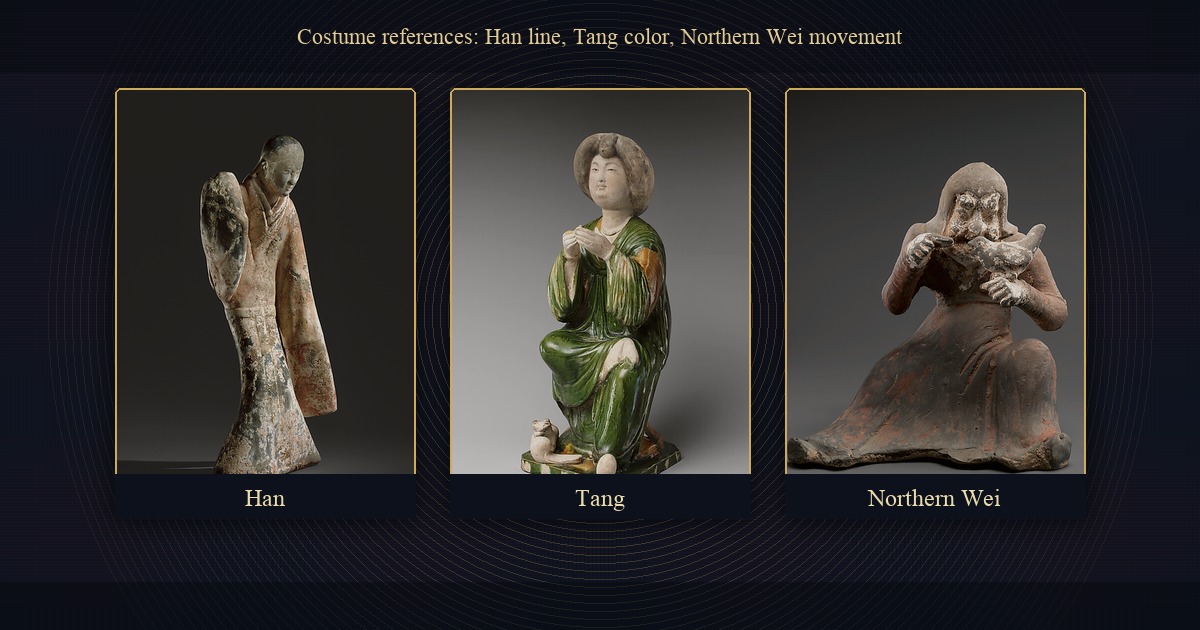
I do not write costume reconstruction. That is the first thing to say, because the palaces in my books belong to imagined dynasties, not one cleanly documented court you can place on a timeline and audit sleeve by sleeve. But I also do not want the clothes to float in fantasy air. A robe should have weight. A sash should know where it sits on the body. A phoenix crown should feel like something that could hurt after an hour. When I borrow from real Chinese costume history, I am usually borrowing a visual grammar: Han formality, Tang color, Northern Wei movement, Buddhist austerity, court textiles that make a woman’s rank visible before she speaks.
Light spoilers follow for atmosphere, symbols, and early-to-mid emotional arcs across all three books.
Historical truth, not historical cosplay
I wrote more about this in What Is an Imagined Dynasty?, but the short version is simple: the fictional courts in these books are built from history without pretending to be history.
That matters most in costume.
If I tied The Emperor’s Caged Bride directly to the Han court, readers would be right to audit every title, robe, marriage custom, and palace ritual against a specific reign. If I set The Cloud Beside the Moon inside Tang, Yueying’s wedding robes would start answering questions about exact court dress regulations. If I made The Emperor’s Last Lie Northern Wei, Changning’s temple years would pull the story toward real dynastic transition and state Buddhism. Those are rich subjects, but they are not the center of these books.
So I use historical costume the way a composer uses old instruments. The sound is real. The song is invented.
Han: long lines, ceremony, and the body under rank
Han references give me the feeling of line: long sleeves, wrapped layers, the body held inside etiquette. The China National Silk Museum’s note on a Mawangdui-inspired curving hem robe is useful because it treats dress as structure, wrapping, tying, and ceremony. The Met’s Western Han female dancer gives another reminder: a sleeve can extend the body into motion, but it can also make the body look less available, less bare, more governed.
That is the feeling behind A-Jiao’s world in The Emperor’s Caged Bride.
When A-Jiao marries the Crown Prince, the scene is full of wedding splendor: red veil, phoenix crown, scarlet robes, candles, gold-thread dragon embroidery on the groom’s chest. On paper, every item says blessing. In the room, every item says replacement. She is wearing the correct bridal language for the wrong marriage.
That tension is why I keep returning to formal dress in her book. A-Jiao is made visible as Crown Princess, then Empress, but visibility does not mean she is understood. Her rank can be announced by crown and robe while her actual self is covered by the dead woman’s memory. Later, when the Emperor tears away her phoenix crown and her hair falls loose, the gesture matters because it strips away the office that was supposed to protect her.
The Han feeling I borrow here is not exact cut. It is the idea that a body can be wrapped in ceremony until the person inside almost disappears.
Tang: color, luxury, and the danger of a beautiful room
Tang references give the books a different brightness. The Met’s seated Tang court lady is described through jacket, sash, skirts, and clear-toned color. That matters because Tang visual culture often feels generous at first glance: color, fullness, ease, music, movement, courtly leisure.
But a beautiful room is still a room.
In The Cloud Beside the Moon, Yueying begins with the opposite of ease. She is dressed in cumbersome court robes for a wedding night that should have confirmed her dignity; instead, those layers become part of the humiliation. The Crown Prince arrives casually, almost carelessly, while she has prepared herself according to rank and ritual. The imbalance is the point. His body is allowed informality. Hers is trapped in formality.
Later, Yueying becomes Empress. By day she puts on the robes of authority and sits in grand halls. By night, after losing a child, she removes hairpins and jewels, wears plain garments, and lets moonlight become the only light in the room. That contrast is one of the clearest costume images in the book. Power has a wardrobe. Grief has another.
The Tang brightness helps me write the surface of that world: banquets, painted faces, music, rich cloth, women’s rooms where pastry, cosmetics, and needlework coexist with strategy. But Yueying’s story keeps cutting through the surface. The golden dragon robe does not suit the Crown Prince in her eyes. She imagines him in plain white instead, walking beside her through clouds. The fantasy is not more splendor. It is less.
That tells you almost everything about her.
Northern Wei: movement, temples, and a colder silhouette
For The Emperor’s Last Lie, I wanted a colder visual grammar.
Changning is not the naive bride entering a palace for the first time. She has already lived through a family disaster, a dead first husband, seven years at Anyuan Temple, and the slow work of becoming a ghost who still breathes. Her story needed less polished court sweetness and more stone, wind, ash, and thinness.
That is where Northern Wei and Northern Wei-adjacent references became useful. The Met’s Northern Wei / Northern Qi seated falconer gives a sense of practical weight and frontier movement. The British Museum’s Northern Wei figure describes robe and scarf edges drawn into tapering, flame-like points, a reminder that drapery can feel sharp, linear, almost calligraphic.
I do not put Changning into a literal Northern Wei court. But I do borrow that sharper edge.
Her first scenes in the palace are full of women ranked by silk and position. A pair of brocade shoes can become a political insult serious enough to cost a life. The Emperor leaves a jade pendant from his sash, and everyone understands that a personal ornament is never only an ornament. Later, that same pendant, carved with the “bundled firewood” image from the Book of Odes, carries the wedding blessing that could never settle into an ordinary marriage.
The most important costume memory in Changning’s book may be red, but it is not simple bridal red. It is the red veil of the first marriage, the wedding sash Li Chengmu could not release, and the imagined alternate life where the person lifting the veil might have been him. Red, in this book, is not only joy. It is the color of a door that opened onto the wrong lifetime.
The three women, dressed by the system
Across the three books, costume is one of the ways the palace tells a woman what she is before she has a chance to answer.
For A-Jiao, dress is substitution. The bridal red, phoenix crown, osmanthus rouge, and Empress regalia all ask her to stand where A-Shuo stood. Even beauty becomes borrowed language. She learns the dead woman’s scent and habits because being herself has not worked.
For Yueying, dress is dignity under assault. The court robes on her wedding night are too formal for the cruelty that follows. The Empress robes later become armor, but not healing. When she removes jewels and powder in grief, she is not becoming weak. She is briefly escaping the performance of invulnerability.
For Changning, dress is evidence. Rank, sash, pendant, veil, mourning paper, Buddhist austerity, and palace silk all point toward hidden histories. Her problem is not that the palace cannot see her. It sees her constantly. It simply insists on reading her as substitute, threat, reward, relic, or tool.
That is why I care about costume even when I am not writing strict historical fiction. Clothes are one of the palace’s languages. They say who may sit, who must stand, who is favored, who is exposed, who is mourning illegally, and who has been dressed as someone else’s memory.
The Palace Titles Guide explains the hierarchy in words. Costume lets the hierarchy reach the skin.
The references I keep returning to
If you want to look at the visual sources behind the mood, these are a few good doorways:
| Reference | What I borrow from it |
|---|---|
| Han female dancer, The Met | Long-sleeved motion, controlled grace, the body extended through cloth. |
| Curving hem robe note, China National Silk Museum | Wrapped structure, etiquette, and the idea of clothing as a social form. |
| Tang seated court lady, The Met | Color, ease, court leisure, and the tension between beauty and enclosure. |
| Northern Wei / Northern Qi seated falconer, The Met | Frontier weight, practical posture, and a less ornamental silhouette. |
| Northern Wei figure, British Museum | Sharp drapery, linear rhythm, and the visual pull toward Buddhist stone and flame. |
None of these objects is a one-to-one costume for a character. They are closer to tuning forks. I look at them to remember how fabric governs movement, how rank becomes visible, and how a beautiful garment can still belong to a story with no easy mercy.
What to read next
If this is the visual doorway you needed, start with the Books page and choose the costume pressure that interests you most: A-Jiao’s bridal substitution, Yueying’s robes of power and grief, or Changning’s jade pendant and temple-shadowed return.
For a spoiler-light map of all three novels, read Three Books, Three Palaces. If you want the objects rather than the clothing, the glossary of palace objects, places, and symbols is the companion piece.
And if you prefer to know the emotional weather before entering, begin with the Reader’s Guide. The clothes are beautiful. The rooms they belong to are not gentle.
- Tia
A free story for new readers
The Empress He Could Not Keep — a complete short story
of empire, obsession, and the impossible return.
Yours when you join the reader list.