The Last Lie — Why Some Tragedies Disguise Themselves as Mercy
Why Li Chengmu carries the truth alone, lets Changning hate him, and turns protection into the final cruelty of The Emperor's Last Lie.
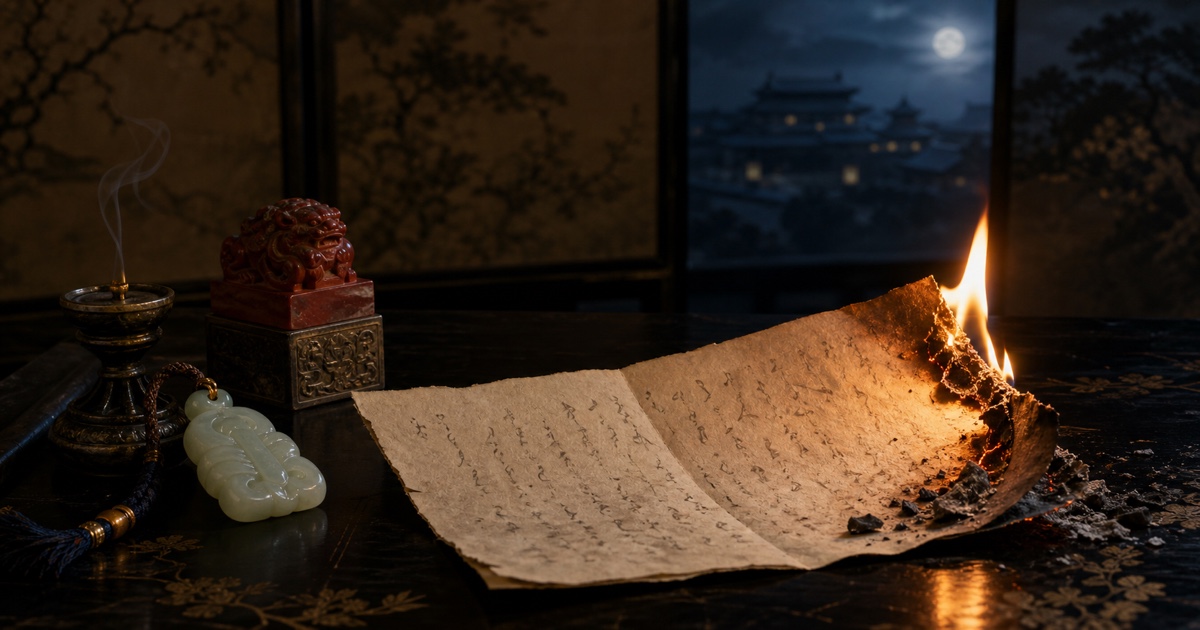
I have always been suspicious of the sentence I lied to protect you. In fiction, it can become a clean excuse too easily: one person takes control of the truth, the other eventually discovers the noble motive, and love is supposed to wash away the theft. The Emperor’s Last Lie is built around that excuse, but I did not want the lie to become innocent merely because it was costly. Li Chengmu’s silence does protect Changning. It also controls the shape of her grief, decides whom she is allowed to blame, and steals the time in which she might have chosen differently. His mercy is real. So is the cruelty inside it. The tragedy lives where those two truths refuse to separate.
Heavy spoiler warning: This essay reveals the palace mystery, the truth behind the Crown Prince’s rebellion, Li Chengmu’s illness and death, Youbai’s letter, and the final pages of The Emperor’s Last Lie. If you have not finished the novel, begin with the spoiler-light Ye Changning character study or the Reader’s Guide.
The last lie is not one sentence
Li Chengmu does not tell one lie at the end. He constructs a life in which truth reaches Changning only in controlled pieces.
He brings her back from Anyuan Temple without explaining the road already built ahead of her. He gives her a false pregnancy and another woman’s child, refuses to explain the rebellion that destroyed her family, hides the poison consuming his body, then sends her away and dies before she can return.
Each act carries the same logic: if Changning knows or witnesses too much, she will not survive it. Therefore he will know and choose on her behalf, carrying the ugliness and leaving her only the future he has arranged.
That is why the title uses the singular lie. The separate deceptions form one moral decision: Li Chengmu appoints himself the guardian of what Changning is permitted to know.
Her return is love designed as infrastructure
At first, Changning’s return looks like imperial impulse. Li Chengmu sees her at Anyuan Temple, points, and orders that she be sent into the palace. The later revelation changes the scale of that moment.
He has already been waiting for a suitable concubine to conceive. His physician-confidant has been monitoring pregnancies. Li Chengmu has deliberately visited low-ranked women from politically weak families until Noble Lady Feng becomes pregnant with what is likely to be a son. Jiang Xiaoqing then stages Feng’s death, allowing the birth mother to vanish while the palace prepares to believe that Changning carries the Emperor’s child.
Only then does Li Chengmu bring Changning back.
He calls the unborn child the first brick in a road meant to protect her for life. The boy will become Li Yanjin, Prince Huai, Crown Prince, and eventually Emperor. Changning will become his official mother. A fabricated Ye clan will give her political roots. By the time Li Chengmu dies, she will have rank, an heir, loyal ministers, and enough authority to stand above every woman who might threaten her.
This is love translated into statecraft: patient, intelligent, and terrifying.
Changning never asked to be pulled from the temple. Noble Lady Feng must surrender the public truth of motherhood. Jiang Xiaoqing must wear the reputation of a monster. One man moves women, bloodlines, ranks, and rumors toward his chosen outcome.
Li Chengmu says every sacrifice is worth the cost because the sacrifice is made for Changning. The novel’s answer is quieter: worth the cost to whom?
I wrote about the child at the center of this design in Children, Succession, and the Mothers Who Pay the Price. Here, what matters is the pattern. Protection is not something Li Chengmu offers Changning. It is a structure he closes around her.
Why he lets her believe he destroyed her family
The cruelest silence concerns the rebellion seven years earlier. Changning believes Li Chengmu and Youbai conspired against Crown Prince Li Chengyu, destroyed the Tong clan, and built a throne out of her dead. When she confronts him, she gives him every opening: whether he says yes or no, she will believe him. She wants one sentence strong enough to keep her world from collapsing.
He refuses.
He tells her only that events are not as she thinks and that she should not know the truth. He lets the accusation remain between them because the real account is worse in a different direction.
Youbai’s letter reveals that Changning’s father, Tong Wei, engineered the Crown Prince’s political isolation and pushed the frightened heir toward rebellion. Tong Wei’s purpose was to save Mei Luoxi and her son—the neglected Fifth Prince Li Chengmu—from Noble Consort Kang and the future rule of her son, Crown Prince Chengyu. Changning’s marriage, her husband’s downfall, the Tong family’s destruction, and thousands of deaths were pieces in her own father’s design.
Li Chengmu did not build his road to the throne by sacrificing Changning. Her father used Changning and almost everyone she loved as the road beneath Li Chengmu’s feet.
That truth would dismantle the last stable version of her past. Her father would cease to be a loyal minister destroyed by the victor. Her marriage would become part of his strategy, her survival the accidental remainder of a sacrifice planned by her own blood.
Li Chengmu chooses to remain the villain because a villain gives grief a single target. Changning can hate him and preserve the dead. If she knows the truth, even mourning becomes contaminated.
This is the most persuasive form of his mercy—and therefore the most dangerous. He is willing to lose Changning to protect her memory of people who did not protect her. But he decides alone. She never gets to choose between a bearable falsehood and an unbearable truth.
The silence protects a woman and a throne
The novel does not let Li Chengmu’s motive become completely pure.
Tong Wei’s scheme required silence so Li Chengmu’s defeat of the rebellion would appear righteous. If the empire learned that the Crown Prince had been manipulated into treason to elevate the Fifth Prince, the legitimacy of the new reign would carry an ineradicable stain. The same truth that might destroy Changning could destabilize the throne on which her future depends.
Mercy and political necessity point in the same direction.
That overlap matters. Li Chengmu is a loving man, but he is also a sovereign. He protects Changning through the machinery of the state, and the machinery benefits from his protection. His silence preserves her father’s image, his own rule, Yanjin’s succession, and the official account of the dynasty all at once.
Only in his final decree does he begin correcting the record. He restores Crown Prince Chengyu and those condemned beside him after he is no longer there to face the political consequences. Even justice is timed to arrive after his death.
Five years disguised as a future
Li Chengmu’s second great silence is inside his body.
At nine, he ate poisoned pastries meant for his mother. The immediate sickness passed, but the damage did not. By the time Changning returns, he knows his remaining life is short. Jiang Xiaoqing eventually tells her the physicians’ limit: at most five years.
Those five years explain the urgency. Li Chengmu is racing to finish Changning’s life after him: place Yanjin in her arms, create a maternal clan, raise her rank, secure alliances, and make her politically unassailable.
Changning hears plans for tomorrow and mistakes them for evidence that they possess tomorrow.
When she learns the truth, she asks him to survive. They turn toward each other at last. They share ordinary evenings, children, arguments over names, and the fragile domestic comedy that palace tragedy rarely permits. Yet even during those gentler years, the deadline remains. Changning counts time by his cough. Li Chengmu continues arranging what will happen when he is gone.
The mercy is the performance of enough normal life that Changning can briefly stop living as a survivor. But every ordinary day becomes something she will later reread as a farewell he refused to name.
No farewell is the final protection
At the end of the fifth year, Li Chengmu insists Changning leave the palace to visit the fabricated Ye family in Taiyuan. She does not want to go. His illness has worsened, and she senses the edge of parting. He sends her anyway, arguing that the appearance must be maintained for Yanjin and Yuchou.
While returning, she stops at Zhaoren Temple and receives Youbai’s letter. At last she learns that Li Chengmu was not the architect of the disaster she blamed on him. She understands how completely he allowed himself to be hated. She runs for the capital, ready to choose the one person still alive.
He dies before she reaches him.
Changning understands that even this was arranged. Li Chengmu held his failing body together until she was away, choosing a death she would not witness. He spared her the helplessness of standing beside someone power could not save.
He also denied her an apology, a thank-you, an answer, and a goodbye.
That is the final cruelty inside his mercy. Li Chengmu protects Changning from watching him die because he cannot bear to leave that image inside her. Yet the absence becomes the image that governs the rest of her life. She spends years driving horses too quickly, as if speed might close the distance left by that one journey. The words they postponed remain permanently unsaid.
He saves her from one unbearable moment and gives her an entire lifetime of arriving too late.
When mercy arrives too late
I do not read Li Chengmu’s last lie as romantic redemption. Love explains his choices; it does not make those choices harmless.
His tragedy is that he understands protection as the removal of risk. If Changning cannot face a truth, hide it. If the palace can threaten her, build a stronger palace around her. If she might see him die, send her away. He keeps trying to eliminate the event that will break her, without recognizing that being denied choice is itself one of the things that has broken her all along.
Changning’s tragedy is that the truth does reach her—but only when it can no longer change the life they share. It clears Li Chengmu of one crime at the precise moment she loses the chance to tell him she understands. Mercy arrives. So does knowledge. Neither arrives in time.
That is why some tragedies disguise themselves as mercy. They do not always come wearing cruelty’s face. Sometimes they arrive as a protected future, a sealed letter, a child in your arms, a decree restoring the dead, or a lover determined to carry the unbearable thing alone.
The intention can be tender.
The wound can still be permanent.
What to Do Next
For the beginning of Changning’s disappearance and return, read Ye Changning — The Woman Who Survived by Disappearing. For the wider pattern of women forced into other women’s places, continue with Substitution as Survival. Full content notes are in the Reader’s Guide, and The Emperor’s Last Lie is available on Kindle and Kindle Unlimited.
There will be more imagined dynasties. More women history forgot. The fourth book is already in early pages, set in the late years of an invented reign. If you’d like to be there when it arrives, Letters from the Inner Palace is where I will write first.
Tia
A free story for new readers
The Empress He Could Not Keep — a complete short story
of empire, obsession, and the impossible return.
Yours when you join the reader list.