Substitution as Survival — How Three Tia Shan Heroines Live Inside Other Women's Names
A spoiler-marked cross-book essay on substitution, survival, and the women forced to inhabit another woman's place.
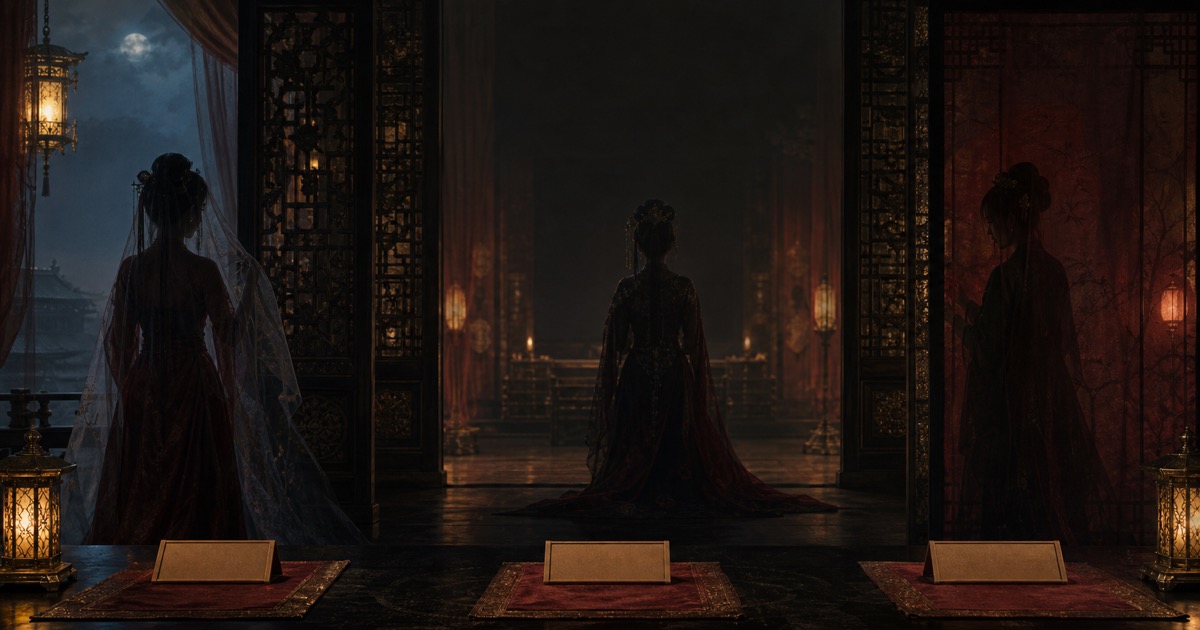
I keep returning to the same wound in different clothes: a woman enters the palace and discovers the room already has a name on the door. Sometimes the name belongs to a dead wife. Sometimes it belongs to the woman who should have held the rank first. Sometimes it belongs to an old self the heroine has tried to bury. In my books, substitution is not only a romance trope or a convenient source of jealousy. It is one of the palace’s basic technologies.
This is a medium-to-major spoiler essay, divided by book. If you have not read a title yet, skip that section and return after.
Substitution is not the same as resemblance
The simplest version of this trope stops at faces: one woman looks like another, and a man confuses desire with grief. What matters in palace fiction is that resemblance becomes administrative. A girl is placed into another woman’s rank, bedchamber, obligations, enemies, and political usefulness. The heroine’s name becomes less important than the function she can perform.
That is why substitution in these books is a survival structure. It tells a woman: you may live, but only if you become legible through someone else.
A-Jiao: substitution by blood and politics
Spoilers for The Emperor’s Caged Bride: This section discusses A-Shuo, A-Jiao’s marriage, Weiyang Palace, and the final revelation of the Emperor’s love.
A-Jiao’s substitution begins before she enters the Eastern Palace.
Her cousin A-Shuo has died. The Cui family still needs a daughter beside the Crown Prince. A-Jiao is the remaining legitimate Cui daughter who can be moved into that opening. No one has to call her a replacement for the violence to be complete. The title does it. The wedding does it. The household memory does it.
A-Shuo was not only the previous wife. She was the model: graceful, accomplished, loved by the Crown Prince, and useful to the Cui family. A-Jiao grows up admiring her, envying her, loving her, and being corrected against her. Then she is sent to occupy the same place.
That is why A-Jiao’s early imitation is so painful. She learns A-Shuo’s osmanthus rouge, reads the books A-Shuo loved, studies the way a dead woman cried and smiled. On the surface, this looks like a young Empress trying to win favor. Underneath, it is self-erasure performed because no one has offered her another path to safety.
If she refuses the comparison, she seems ungrateful and politically useless. If she accepts it, she becomes a shadow in her own marriage. I wrote about A-Shuo’s absence more fully in The First Wife Who Was Already Dead, but here the key is this: A-Jiao is not merely haunted by A-Shuo. She is organized around A-Shuo. Her marriage, shame, family duty, and the forbidden word “brother-in-law” all come from the fact that the man beside her once belonged to someone close enough to make the marriage feel wrong before it begins.
The final twist makes that structure crueler, not softer. The Emperor did not spend his life loving A-Shuo and failing to love A-Jiao. He loved A-Jiao, but he let the whole palace read his desire through the safer story of the dead first wife. A-Shuo’s name becomes the screen everyone uses: A-Jiao uses it to explain his coldness, the Cui family uses it to measure her failure, and the Emperor uses it to hide the humiliating truth of wanting the girl once promised elsewhere.
That is the tragedy. Substitution does not need to be factually correct to ruin a life. It only needs enough people to organize reality around it.
Yunnong: refusing to become replaceable
Spoilers for The Cloud Beside the Moon: This section discusses Qin Yunnong’s rise, Mianmian’s death, Yueying’s revenge, and Yunnong’s downfall.
Qin Yunnong is the inverse of A-Jiao.
She is not introduced as a dead woman’s replacement. She is introduced as the woman who took a living woman’s expected place.
Yueying should have been Crown Princess by birth, rank, and politics. She is the granddaughter of the Grand Chancellor, the kind of bride a court can understand. Instead, the Crown Prince chooses Yunnong, the daughter of a fifth-rank official, after a supposedly fated encounter at Juexin Temple. Love lifts Yunnong into a seat that the palace believes belongs to someone else.
That sounds like triumph. For Yunnong, it is also terror. Every day she sits as Crown Princess, the comparison sits with her. If she governs well, people can say she is merely working hard to deserve an unlikely rank. If she fails, Yueying’s name waits nearby as the obvious correction. Yunnong does not need Yueying to openly compete with her. Yueying’s existence is competition enough.
That is the seed of Yunnong’s violence.
She cannot bear to be treated as accidental: the woman chosen by romance but judged by rank. Most of all, she cannot bear the thought that another woman’s love might look purer, deeper, more deserving, or more useful than her own.
Mianmian threatens her from below. Yueying threatens her from the side. One is too sincere; the other is too proud. Mianmian’s direct devotion begins to look like something Yunnong cannot control. Yueying does not want him, which is somehow worse. A rival who refuses to worship him exposes the instability of the whole system.
Yunnong’s answer is not to become anyone’s substitute. Her answer is to make every other woman secondary.
That is why she is frightening. As I wrote in Qin Yunnong: Villain, Survivor, or Both?, her fear is understandable, but her choices are not innocent. She turns care into a weapon. She feeds Mianmian’s longing until longing becomes fatal. She helps create the conditions of Yueying’s first wound, then later tries to keep Yueying’s body and future under control. She wants to be the only one who loves correctly.
Yunnong’s tragedy is that she rejects substitution so completely that she becomes its enforcer.
She refuses to be the lesser wife, the lucky accident, the fragile favorite waiting to be replaced by a better-born woman. To secure that refusal, she makes other women carry the terror for her. Mianmian becomes the foolish lover. Yueying becomes the wrong woman with the wrong kind of pride.
Yunnong dies having protected nothing cleanly. She has a son, but Yueying raises him. She has love, but the throne pulls the Emperor away even at the end. She has the title, then loses control of the story it was supposed to secure.
In A-Jiao’s book, substitution is imposed by family and politics. In Yunnong’s case, the fear of substitution becomes a motive for harm. The palace teaches her that if she cannot be original, she will be erased. So she spends her life proving she cannot be replaced.
Changning: too many names for one survivor
Spoilers for The Emperor’s Last Lie: This section discusses Tong Yuer, Ye Changning, Imperial Noble Consort Lin, the constructed Ye identity, and the late-book revelations about Changning’s father.
Changning’s story is the most explicit version of substitution, but also the most layered.
At first, the palace thinks it understands her. She is a low-ranked Second Attendant brought in from Anyuan Temple: older than a new concubine should be, previously married, politically suspicious, and far too favored for her place. Soon the harem finds the explanation it needs: she resembles the late Imperial Noble Consort Lin, the Emperor’s dead favorite, whose childhood name was also Yu’er.
That explanation is convenient because it makes Changning smaller. If she is only Lin’s substitute, then she does not need a past of her own. She does not need to have been Tong Yuer, daughter of Chief Protector Tong, wife of the former Crown Prince, and the girl Li Chengmu loved before treason rearranged the world. The court can reduce her to face, voice, rumor, and imperial obsession.
Changning resists this with almost comic precision. She insists she is Ye Changning. She corrects the wrong name. She clings to the identity built at Anyuan Temple because the old name belongs to a destroyed family and a life she cannot restore. But even Ye Changning is not simple freedom. The name lets Tong Yuer survive, but it also hides her. Later, when Li Chengmu constructs a Ye family connection for her political future, even her borrowed surname becomes a court instrument.
This is why Changning is different from A-Jiao and Yunnong. A-Jiao is asked to stand where A-Shuo stood. Yunnong fights the possibility that Yueying might replace her. Changning has to survive several substitutions at once: Lin’s echo to the palace, Yuer to Li Chengmu, Ye Changning to herself, and later a mother of heirs made legible by a manufactured clan.
Then the final truth widens the pattern. Changning learns that substitution did not begin with Lin. Her own father had used resemblance before, loving a woman who reminded him of Mei Luoxi, and later sacrificing his family to save Mei’s son. Changning, Youbai, and the other women around that history are not exceptions. They are part of a system where men turn women into vessels for old desires, old loyalties, and old regrets.
I wrote in Ye Changning’s character study that her disappearance is a boundary, not a cure. Here is the other half: substitution makes disappearance tempting because visibility becomes dangerous. If being seen means being misnamed, used, ranked, and arranged, then vanishing can feel like the only way to keep one unruined part of the self.
That is not simple healing. It is survival with seams showing.
Why the pattern matters
Across these three books, substitution changes shape.
A-Jiao is moved into a dead woman’s marriage. Yunnong refuses to be displaced and makes other women pay for the fear. Changning is trapped among names until she has to decide which one can carry the life that remains. What links them is not only romance. It is architecture.
The palace has few original rooms for women. It offers wife, widow, consort, mother, favorite, rival, vessel, ghost. When a woman does not fit cleanly, the system solves the problem by naming her through someone else. You are the new A-Shuo. You stole Yueying’s seat. You are Lin’s shadow. You are Yuer. You are not allowed to be only yourself because “only yourself” has no rank, no legal force, no political use.
That is why substitution keeps returning in my work. It lets me ask what identity costs when survival depends on being readable to power.
The cruel answer is that being misread can still keep you alive. A-Jiao’s position gives her enough authority to protect her son, even as it cages her. Yunnong’s chosen-wife story gives her rank, even as the fear beneath it turns her monstrous. Changning’s Ye identity gives her a future, even when that future has been partly engineered by the man who loves her. None of these roles are false in a clean way. None are true in a clean way either.
That is the palace’s genius. It does not always destroy women by denying them names.
Sometimes it destroys them by giving them names that are almost useful enough to keep.
What to Do Next
If this essay is your first stop, begin with Three Books, Three Palaces for a spoiler-light introduction to all three standalone novels. For content notes and reading order, use the Reader’s Guide.
To follow the substitution thread in the books themselves, start with The Emperor’s Caged Bride for the replacement bride, The Cloud Beside the Moon for the woman who refuses to be replaceable, or The Emperor’s Last Lie for the substitute consort whose name keeps changing shape.
And if you want the broader map of titles and rank behind these wounds, keep the Palace Titles Guide nearby.
In the palace, a name can be a cage.
It can also be the last tool a woman has left.
Tia
A free story for new readers
The Empress He Could Not Keep — a complete short story
of empire, obsession, and the impossible return.
Yours when you join the reader list.