Qin Yunnong — Villain, Survivor, or Both?
A spoiler-heavy character study of Qin Yunnong, whose softness, fear, and need to love properly make her one of Tia Shan's most frightening women.
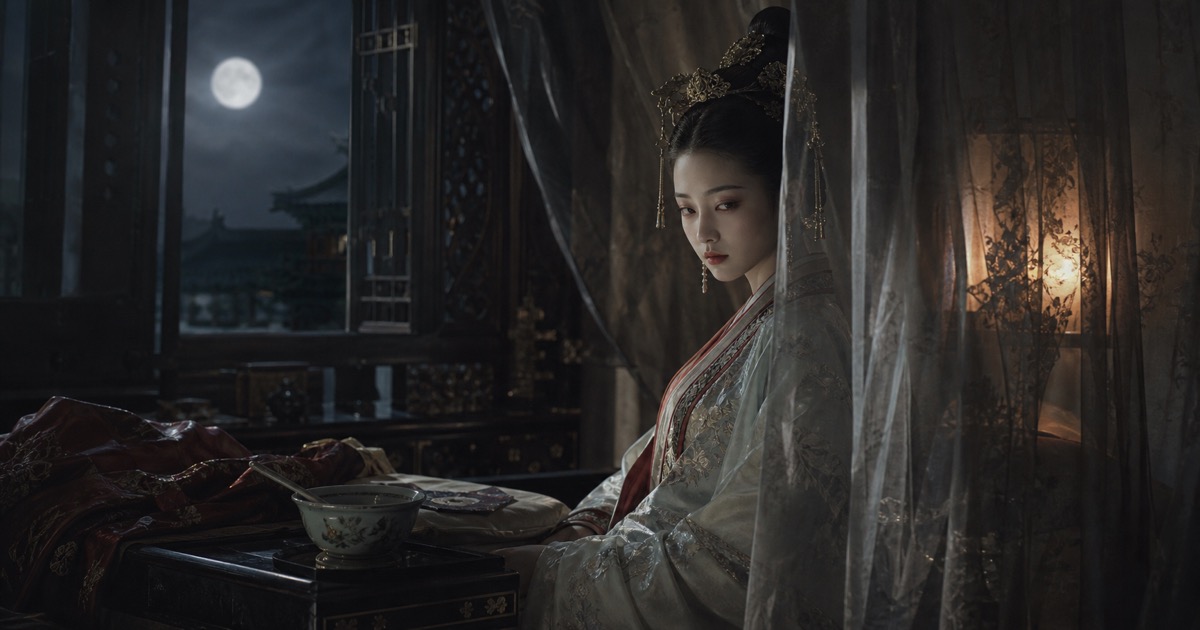
I find Qin Yunnong frightening in the way a quiet room can be frightening after you notice every door has been locked from the inside. She is not the loudest woman in The Cloud Beside the Moon. She does not enter the story with a knife in her sleeve or a threat on her tongue. She is gentle, beautiful, diligent, grateful, and visibly under pressure. That is exactly why she matters. Yunnong’s cruelty does not look like cruelty until the damage is already done. She understands how to make violence pass through care, how to turn sympathy into cover, and how to call possession by the prettier name of love.
Major spoiler warning: This character study discusses Hu Mianmian’s death, Yueying’s wedding night trauma, Yunnong’s schemes, Yunnong’s illness and death, Gu Zhiyi, and the later shape of Yueying’s revenge.
She is not frightening because she is strong
Yunnong begins from a position that is more precarious than it looks.
She is the Crown Princess, yes. She is the woman Gu Ming chose in defiance of the Empress, the woman loved so publicly that every other woman in the Eastern Palace must build a life around that love. But her title rests on an unstable foundation. She is the daughter of a fifth-rank official. Yueying is the granddaughter of the Grand Chancellor. In a palace where rank is not decoration but oxygen, Yunnong knows everyone can see the mismatch.
That pressure does not excuse her. It does explain why she calculates so early.
If she manages the household perfectly, people can say she only did what a lower-born woman must do to deserve her seat. If she makes one mistake, everyone can compare her with the woman who should have been Crown Princess. Yueying does not need to scheme against her in order to threaten her. Yueying’s birth, face, pride, and very indifference are enough.
That is the first key to Yunnong: she is not frightened because she is weak. She is frightening because fear teaches her discipline.
Love becomes a claim of ownership
The most dangerous thing about Yunnong is that she believes her love is morally superior.
In her mind, she does not merely want Gu Ming. She loves him correctly. She yields to him, tends him, understands him, and protects the romance she believes Heaven itself blessed at Juexin Temple. When she looks at the other women, she does not only see rivals. She sees women who have no right to love him wrongly.
That distinction is vicious.
Mianmian’s love is too obvious, too innocent, too unguarded. Yueying’s refusal is even more intolerable. Yunnong can understand a rival who wants rank. She can understand a woman who wants favor. What she cannot bear is a woman who receives Gu Ming’s attention and refuses to worship it.
This is where Yunnong becomes more than jealous. She turns love into jurisdiction. Only she is allowed to cherish him properly. Only she is allowed to define what his tenderness means. Only she is allowed to turn his flaws into a private mythology. Anyone who contradicts that mythology has to be corrected, humiliated, or removed.
The result is not romantic devotion. It is possession wearing the clothing of tenderness.
Her violence is deniable
Yunnong’s softest weapon is plausibility.
She does not kill Mianmian with poison. She does not openly forbid the Crown Prince to visit her. She does not announce herself as an enemy. Instead, she learns the shape of Mianmian’s longing and keeps pressing it where it hurts.
She talks about the Crown Prince when Yueying is absent. She repeats the temple story, the story of being chosen, the story of arriving one step ahead. She knows Mianmian’s body and pulse records. She knows when a visit will look like kindness and when a visit will deepen the wound. Every action can be defended separately. A story is only a story. A visit is only a visit. Concern is only concern.
Put together, they become murder by atmosphere.
That is why I resist making Yunnong a simple “scheming woman” type. The horror is more specific. She understands that a palace rewards the person who can harm without appearing to act. A public slap can be punished. A wrong word at the right time can pass as conversation.
In Hu Mianmian’s character study, I wrote that Mianmian shows us what the palace costs the sincere. Yunnong shows us the opposite: what the palace teaches the frightened intelligent woman to do with sincerity once she recognizes it as a weakness.
She knows the rules before Yueying does
Yueying spends the early part of the novel trying to remain above the ugliness.
She does not want Gu Ming. She does not want the Crown Princess’s seat badly enough to fight for it. She wants dignity, distance, her daughter, and the small private warmth of friendship. Yunnong knows earlier than Yueying that this is not how the Eastern Palace works.
The palace does not allow a woman to opt out cleanly. A woman who refuses to compete may still become useful in someone else’s competition. Yueying’s first tragedy is that her dignity becomes a tool in Yunnong’s hands. Her wedding night wound is not merely Gu Ming’s drunken cruelty. It is also, by Yueying’s later understanding, the result of Yunnong deliberately provoking him, knowing his temper after wine, and sending him toward the woman whose pride needed to be broken.
That is why Yunnong is Yueying’s mirror as much as her enemy.
Yunnong learns the grammar of the palace first: timing, illness, rank, visits, mothers, servants, physicians, public sympathy, private pressure. Yueying’s revenge becomes possible only when she becomes fluent in the same grammar. This does not make the two women identical. It makes their conflict tragic because one teaches the other how to survive badly.
I wrote in Ruan Yueying’s character study that Yueying does not defeat Yunnong by remaining pure. She defeats her by learning the language Yunnong already speaks.
Survivor is not an acquittal
So is Yunnong a survivor?
Yes.
She enters a palace that was never going to treat her security as settled. Her lower birth is visible. Her mother makes everything worse with crude arrogance. Her husband’s love is real, but his love is also immature, vain, and dependent on being adored. The Empress dislikes her. Her body fails her. Her position depends on producing a son, so she harms herself to conceive and then spends the rest of her life paying for the victory.
That is survival under palace pressure.
But survival does not acquit her.
Yunnong takes her fear and converts it into other women’s ruin. She does not merely defend herself from a system that threatens her. She uses the system with precision against women who are also trapped inside it. Mianmian is not a political rival. Yueying does not begin as an aggressor. Even later, when Yueying becomes dangerous, that danger is something Yunnong helped create.
This is the line I would draw: Yunnong’s fear is understandable; her choices are not therefore innocent.
A palace can explain why someone reaches for a weapon. It cannot make the wound disappear from the person struck.
Why her ending feels like punishment and recognition
Yunnong’s downfall is cruel because it repeats her own method.
Yueying does not simply expose her. She isolates her. She watches the pulse records. She lets Madam Qin reveal too much. She allows Gu Ming’s dependence to drift elsewhere. She tends Yunnong’s sickbed with visible devotion and says the words most likely to tear open the heart underneath the illness.
It is revenge in the same key as the original crime: pressure applied through longing, fear, timing, and plausible care.
That symmetry is satisfying for only a moment. Then it becomes unbearable.
By the end, Yueying can no longer pretend revenge has restored anything clean. Yunnong asks to see Gu Ming. Yueying knows he will not come. The Emperor is dying; the court needs the Crown Prince; Yunnong, despite all her love, is not important enough to make him step away from power at the final hour. That is the sharpest judgment the novel passes on her dream.
She wanted to be the only woman who loved him properly.
She dies discovering that love, however fervent, still loses to the throne.
What she leaves behind
Yunnong leaves a son, Gu Zhiyi, and that matters.
Through him, the novel refuses to let revenge stay abstract. Yueying does not merely defeat a rival and move on. She raises the child of the woman she helped destroy. Gu Zhiyi becomes innocent love, living accusation, and one of the reasons Yueying can never sort justice from sin again.
That is one reason Yunnong remains important after her death. She is not only the villain who caused Mianmian’s death. She is also the woman whose absence keeps shaping Yueying’s motherhood, guilt, and fear for years afterward.
Across my three palace tragedies, women are often forced into roles built by other women’s absence. A-Jiao lives inside the space A-Shuo left behind. Changning is misread through the dead Imperial Noble Consort Lin. Yunnong is different: she refuses to become secondary to anyone, then makes other women pay for the terror of being replaceable.
That refusal is human.
The cost is monstrous.
Villain, survivor, or both?
Both, but not equally.
Yunnong is a survivor in origin and a villain in action. The first explains the second’s pressure. It does not soften the second’s consequences.
I do not want readers to excuse her. I want them to see why she is frightening. She is frightening because she is not stupid, not cartoonishly cruel, not careless with power. She knows exactly which wound belongs to which woman. She knows how to make harm look like concern. She loves with all the sincerity in her body and still turns that sincerity into a blade.
The palace did not invent her fear from nothing.
But Yunnong chose where to point it.
That is why she lingers. Not because she is the worst person in the room, but because she is one of the clearest examples of what the room can teach a woman to become when love, rank, fear, and calculation are allowed to share one name.
What to Do Next
If you want to read the full story of Yunnong, Yueying, and Mianmian, start with The Cloud Beside the Moon, available on Kindle and Kindle Unlimited.
If you need content notes first, begin with the Reader’s Guide. For the wider vocabulary of rank that shapes Yunnong’s fear, keep the Palace Titles Guide open. Then read Female Friendship as Palace Warfare for the broader pattern of tenderness becoming leverage inside the inner palace.
And when Yunnong seems soft, look again.
Soft things can still cut.
Tia
A free story for new readers
The Empress He Could Not Keep — a complete short story
of empire, obsession, and the impossible return.
Yours when you join the reader list.