Ruan Yueying Character Study — Pride, Revenge, and the Price of Staying Clean
A character study of Ruan Yueying, whose pride keeps her alive, whose revenge wins the palace, and whose clean hands do not survive.
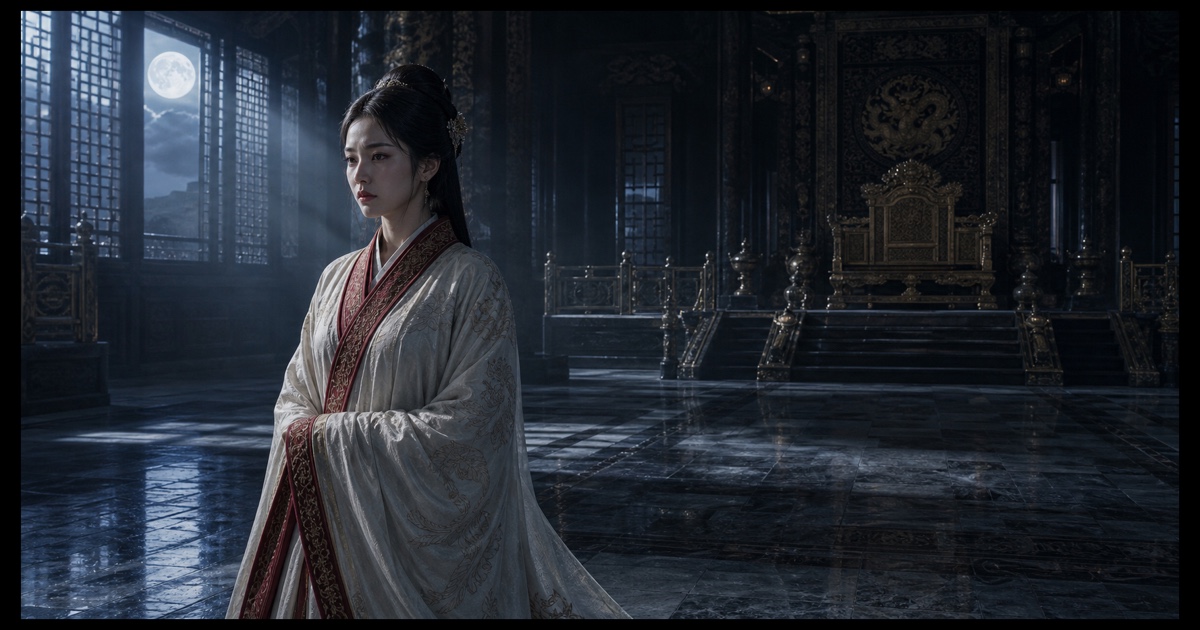
When I think about Ruan Yueying, I do not first think of revenge. I think of posture. A straight back. A cold face. A woman who refuses to let anyone see how badly the first wound landed because dignity is the only room inside herself that no one has managed to enter by force. In The Cloud Beside the Moon, Yueying’s pride is not ornamental. It is not vanity. It is the last structure left standing after the palace takes rank, safety, friendship, motherhood, and love, then asks her to call survival a blessing.
Major spoiler warning: This character study discusses Yueying’s wedding night trauma, Mianmian’s death, Qin Yunnong’s downfall, Wen Shuer, child loss, Yueying’s final illness, and the ending.
Pride is the first defense
Yueying enters the Eastern Palace with the sort of birth that should have made her life legible. She is the legitimate daughter of the Ruan clan, granddaughter of the Grand Chancellor, and trained to believe status will protect the outline of her dignity.
Instead, she becomes a Secondary Consort.
Yueying knows she was not born to stand behind Qin Yunnong, who became Crown Princess because the Crown Prince insisted on choosing love. The demotion wounds her pride; the wedding night wounds the part of her pride that had still believed ceremony could protect her.
Afterward, Yueying does not become soft around the wound. She becomes orderly. She retreats into her courtyard, raises Chan’er, keeps her face cold, and refuses to envy the love that everyone else believes she should want. That refusal is often mistaken for superiority. The truth is harsher. Pride gives her a way to stand upright when she cannot undo what happened.
Mianmian makes neutrality impossible
For a while, Yueying tries to stay clean by staying apart.
She does not love the Crown Prince. She does not fight Qin Yunnong for the principal wife’s seat. She treats Hu Mianmian’s lovesickness with teasing, exasperation, and affection, but she does not fully understand it. Yueying thinks refusing to participate in the palace’s ugliness might keep her from becoming ugly.
Then Mianmian dies.
Mianmian’s death is not only the loss of Yueying’s dearest friend. It destroys Yueying’s private excuse. When Yingying reveals that Qin Yunnong had been feeding Mianmian’s obsession, studying her condition, and timing kindness like a weapon, Yueying sees the cost of her own distance.
That is why Mianmian’s death does more than trigger revenge. It changes Yueying’s understanding of innocence.
In Hu Mianmian — The Girl Who Loved Too Brightly, I wrote that Mianmian shows us exactly what the palace costs. For Yueying, she becomes something even more unbearable: proof that moral distance can look like neglect when the water has already risen around someone you love.
Yueying begins her revenge with steady hands, not because she has become fearless, but because grief finally has a direction.
Qin Yunnong is a mirror, not only an enemy
Qin Yunnong is frightening because she understands the palace earlier than Yueying does.
Yunnong knows love can be staged. She knows a visit can injure more precisely than an insult, and that weakness, illness, motherhood, and generosity all have political uses. Yueying’s revenge becomes possible only after she learns the same grammar.
This is where Yueying’s character becomes morally interesting. She does not defeat Yunnong by remaining pure. She defeats her by becoming fluent in the same language.
Yueying lets Gu Ming see her tears at the correct moment. She uses household authority, the Empress’s dissatisfaction, Madam Qin’s temper, Wen Shuer’s loyalty, the sickbed, and the Crown Prince’s growing emotional dependence. She stops refusing to use the palace’s cruelty.
That does not mean Qin Yunnong is absolved. Yunnong deliberately ruins Mianmian, engineers the conditions of Yueying’s first wound, attempts to make Yueying barren, and calls her own possessive love a kind of right. But Yueying’s confrontation with her matters because the two women understand each other too well by the end: love, rank, fear, and injury have been knotted together until neither woman can pull one thread free.
She wins. It gives her no peace.
Winning makes her more afraid
After Yunnong dies, Yueying becomes Empress. From outside, her life looks triumphant: the Secondary Consort secures the phoenix seat, raises children, governs the harem, and becomes indispensable.
Yueying knows she helped drive Yunnong toward death. She knows she used the same slow method Yunnong once used against Mianmian: not a single clean blow, but pressure applied through longing, fear, jealousy, and timing. When Yunnong’s son Gu Zhiyi comes under Yueying’s care, he becomes both child and accusation.
This is the moment Yueying discovers the price of staying clean: she did not stay clean.
I wrote in Why The Cloud Beside the Moon Is Not a Romance that revenge is not foreplay in this book. It is the spine. But a spine can also become a cage.
She acts the virtuous wife because it protects the children, stabilizes the palace, and prevents the past from being examined too closely. That is exactly what makes it frightening: she becomes good at the life she never wanted.
The almost-love is her sharpest refusal
There is a moonlit night when she looks at Gu Ming clearly and sees the man he might have been: gentle, beautiful, frightened, almost reachable. For one instant, love becomes truly possible.
Then she refuses it.
That refusal is the center of Yueying’s pride. She is not cold by nature. She refuses because loving him would require a private revision of history. It would ask her to fold the wedding night into later tenderness and call the whole thing marriage.
Yueying cannot accept that bargain. Her pride may be harsh, but it protects a truth the palace keeps trying to soften: he hurt her before he learned how to cherish her. His sorrow does not grant him the right to be forgiven.
This is why Yueying’s final answer to him matters. She admits there was one instant of love, but she refuses to let that instant become the meaning of her whole life.
The hands that carried her are stained too
Yueying’s tragedy is not only that she loses friends. It is that the friends who try to save her are changed by the attempt.
Wen Shuer begins as one of the gentlest forms of loyalty in the novel: practical, warm, funny, frightened, devoted. But even Shuer’s love does not remain untouched. She harms Shen Luoning’s unborn child because Shen insulted Yueying, then spends years punishing herself for it. Later, when pregnancy finally comes, the old sin returns through madness, premature labor, and death.
Yueying cannot stand outside that guilt. Shuer sinned for her sake, as surely as Yueying sinned for Mianmian’s.
That is the book’s cruelest moral pattern. Love does not purify these women. Love gives them reasons they can bear to name while doing things they may never forgive. In Female Friendship as Palace Warfare, I described this as tenderness made dangerous by structure. Yueying’s life is the clearest example.
What Yueying leaves behind
By the end, Yueying has almost everything a palace woman is supposed to want. She leaves anyway.
Stopping her medicine is not a romantic death. It is an exhausted refusal to keep performing a life that has already taken too much. When Gu Ming begs her to stay, Yueying’s final judgment is merciless because it is precise. He wants his love to count as proof. She asks what that love ever cost him.
Mianmian loved until it killed her. Yunnong loved until she became monstrous. Shuer loved until guilt and devotion destroyed her. Yueying loved once, briefly, and spent the rest of her life refusing to let that moment excuse the wound that made it impossible.
Her pride does not save her from pain. Her revenge does not restore Mianmian. Her rank does not make the palace less lonely. But her final refusal preserves one thing: the right to name her own life without letting the man who wounded her turn it into his tragedy instead.
Yueying does not die as a lesson in forgiveness.
She dies as the woman who saw the palace clearly enough to know that winning was never the same as being free.
What to Do Next
If you want to read Yueying’s full story, start with The Cloud Beside the Moon, available on Kindle and Kindle Unlimited.
If you need content notes first, begin with the Reader’s Guide. For the wound that begins Yueying’s revenge, read Hu Mianmian’s character study. For the broader shape of the novel, continue with Twenty Years of Revenge or Why The Cloud Beside the Moon Is Not a Romance.
And when Yueying turns away from love under the moon, do not call it coldness too quickly.
Sometimes refusal is the last form dignity has left.
Tia
A free story for new readers
The Empress He Could Not Keep — a complete short story
of empire, obsession, and the impossible return.
Yours when you join the reader list.