The Final Twist in The Emperor's Caged Bride, Explained
A spoiler-heavy explanation of whom the Emperor truly loved, why the ending changes the whole novel, and why the reveal is still not a happy ending.
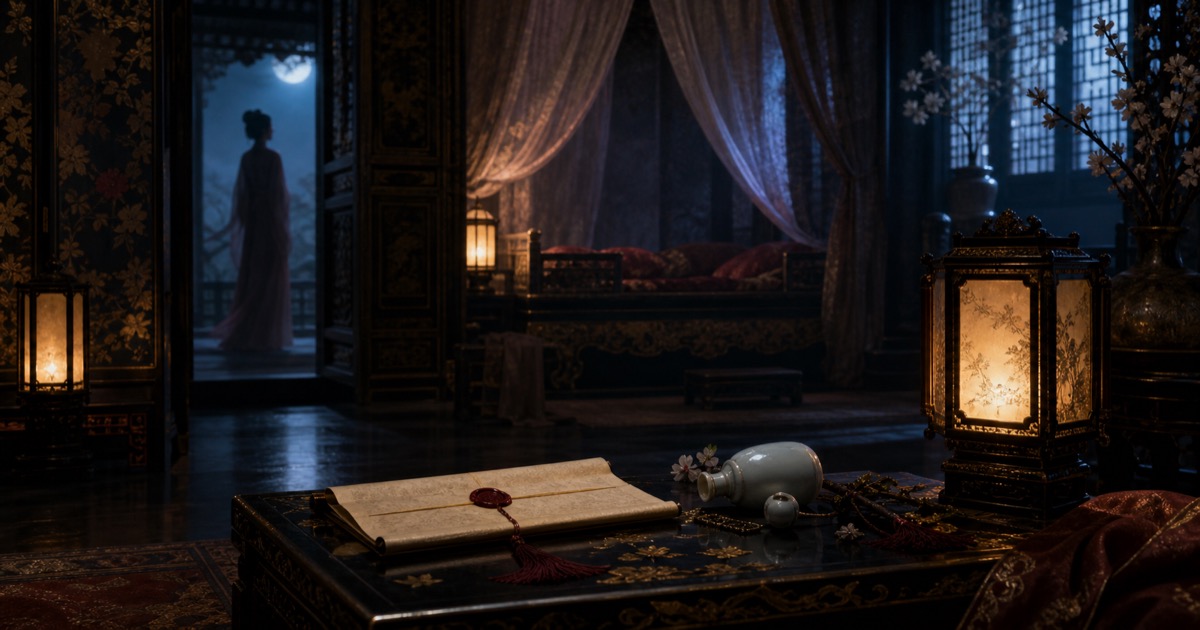
Ending explanations can become a little too tidy, and The Emperor’s Caged Bride is not a tidy book. Its final twist is not a puzzle box clicking shut. It is a wound opening backward through the story, making earlier scenes sharper, uglier, and more tragic than they first appeared. When readers ask me what the ending means, the simplest answer is easy: the Emperor loved A-Jiao, not A-Shuo. The truer answer takes longer. He loved A-Jiao, but he loved her through pride, silence, jealousy, and imperial power until love became another structure of harm. This article is for readers who have finished the novel and want to sit with the ending without softening it.
Major spoiler warning: This article explains the final chapter, A-Jiao’s death, A-Miao’s epilogue, the Emperor’s true attachment, and why the ending is not a romance-style happy ending. Read The Emperor’s Caged Bride first if you want the twist unspoiled.
What the twist actually reveals
The final twist is delivered through A-Miao, not A-Jiao.
That choice matters. A-Jiao does not sit up in bed, hear the full truth, and receive a confession that can change the life she is living. The answer comes years later, after the main story has already ended, after the court has turned her death into official language, and after the Emperor himself is near death.
The records say that Emperor Kaiwu married two Cui women in succession. Later generations remember them as the Elder Cui Empress and the Younger Cui Empress. After A-Jiao dies, he never installs another empress. When he dies at forty-two, he is buried with the Younger Cui Empress, A-Jiao, while A-Shuo is placed elsewhere.
Then A-Miao tells us the more intimate version. For years she has wondered which dead cousin the Emperor mourned. Everyone says she looks most like A-Shuo, while her temperament is closer to A-Jiao’s. The Emperor summons her, watches her, and grieves in ways she cannot interpret. Only on his deathbed does the answer become clear. He mistakes A-Miao for A-Jiao and speaks as if he has been waiting across a lifetime to say what he never said when it mattered.
The woman he had always loved was Cui A-Jiao.
Not A-Shuo.
That is the twist. The story A-Jiao believed, the story the Cui family believed, the story the palace servants believed, and the story many readers are trained to believe turns out to be incomplete. A-Jiao was not only the replacement bride in the Emperor’s heart. She was the woman he wanted and could not bear to want honestly.
Why we believe the wrong answer
The novel works because the wrong answer is persuasive.
Before A-Jiao enters the Eastern Palace, everyone already knows the public legend: A-Shuo and the Crown Prince were a perfect pair. She was the brilliant first wife, the graceful Cui daughter, the woman who belonged beside him. A-Jiao grows up inside that legend. She admires A-Shuo, envies her, grieves her, and then is ordered to take her place.
On the wedding night, the Crown Prince asks about A-Jiao’s childhood name, then tells her she looks like A-Shuo. He speaks the dead wife’s name at the very threshold of the new marriage. A-Jiao has no reason to read that moment generously. She is sixteen, frightened, and being touched by the man she still thinks of as her brother-in-law.
After that, the evidence seems to keep gathering. A-Jiao learns the habits associated with A-Shuo. She studies the dead woman’s rouge, books, expressions, and emotional posture because she believes imitation is the only language the Emperor might recognize. Consort Wei’s resemblance to A-Shuo appears to confirm the pattern. The palace has supplied A-Jiao with one explanation, and every room seems to repeat it back to her: he loved the first wife, and the second wife is failing to be her.
This is why A-Shuo’s absence is so powerful. She is not physically present, but she organizes the marriage. I wrote more about that pressure in The First Wife Who Was Already Dead, because A-Shuo’s ghost is not simply romantic competition. She is the approved version of a Cui daughter, preserved by death and made impossible to defeat.
The twist does not erase that structure. It makes it crueler. A-Jiao is not failing to become the woman the Emperor truly loved. She is destroying herself inside a false explanation that everyone, including the Emperor, allows to stand.
What the Emperor is hiding
The twist does not mean the Emperor never cared for A-Shuo. He may have grieved her. He may have honored her. The point is not that A-Shuo meant nothing.
The point is that A-Shuo becomes a screen.
She is a safer story than the truth. It is easier for the Crown Prince to let the palace believe he is mourning a suitable first wife than to admit that his desire has turned toward the young cousin who was once expected to marry Prince Ning. It is easier to speak A-Shuo’s name than to say A-Jiao’s with honesty. It is easier to make A-Jiao feel like an imitation than to confess that the living woman in front of him is the dangerous one.
Why dangerous? Because A-Jiao already has a love story before him.
Prince Ning is not just a rival. He is proof that A-Jiao’s heart once moved freely in a direction the Emperor did not control. When the Emperor punishes Prince Ning, he is not only protecting the throne or settling court politics. He is attacking the life A-Jiao might have chosen if anyone had allowed her choice to matter.
That is why the corruption case and the exile feel so personal beneath their political surface. The Emperor’s jealousy travels through imperial machinery. A private wound becomes a court case. A romantic rival becomes a criminal. A-Jiao’s old tenderness becomes evidence used against everyone near it.
For a fuller character reading of that pattern, I would pair this article with The Emperor in The Emperor’s Caged Bride. Here, the important thing is simpler and colder: the twist reveals feeling, but it also reveals cowardice. He cannot say love plainly, so he lets A-Jiao suffer inside the wrong story.
Why the twist changes earlier scenes
Once you know the ending, several earlier moments change shape.
The wedding night is no longer only a scene of replacement. It is also a scene of concealment. He asks for A-Jiao’s childhood name, but he places A-Shuo’s name over the moment. The two gestures fight each other. One reaches toward the girl herself. The other hides that reaching under a dead woman’s shadow.
A-Jiao’s imitation of A-Shuo becomes even more heartbreaking. She is not moving closer to the truth. She is moving further from herself for a man who already wanted the self she is erasing. Every jar of osmanthus rouge, every borrowed habit, every attempt to perform the dead woman’s grace becomes wasted labor.
His rage over Prince Ning becomes legible as jealousy, not mere dynastic suspicion. He does not behave like a widower protecting a dead wife’s memory. He behaves like a man enraged that the living woman he wants still carries another man’s name inside her history.
The word “brother-in-law” also changes. A-Jiao uses it as a blade because it restores the buried facts. He was A-Shuo’s husband first. A-Jiao was sent into a place already marked by another woman. The marriage carries a wrongness ceremony cannot wash clean. When she calls him by that name, she forces him to inhabit the role he has been trying to overwrite.
Most of all, the poison scene changes. When A-Jiao is dying, the Emperor finally accepts the name “brother-in-law” and admits that he schemed to marry her. On a first read, that confession may feel like panic. On a reread, it is the central truth breaking through after years of control. He did not accidentally receive A-Jiao as a replacement. He wanted her, maneuvered for her, and then punished her for not loving him back in the shape he demanded.
That is why the twist hurts. It does not say, “He loved her, so the pain was a misunderstanding.”
It says, “He loved her, and the pain came partly from the way he loved.”
Why A-Jiao never gets the truth in time
The cruelest part of the ending is not that the truth is hidden from the reader until the epilogue. It is that the truth is hidden from A-Jiao until it can no longer save her.
At the end of the main story, A-Jiao is exhausted beyond ordinary heartbreak. She has been separated from Prince Ning, used as a political piece by the Cui clan, frightened in her own marriage, confined in Weiyang Palace, and forced to plan for her son’s future from inside a life she no longer believes she can survive.
When she takes poison, she does not do it because one conversation went badly. She does it after years of doors closing. She arranges Wang’er’s future. She places what authority she has left into motion. Then she exits the only way she can still control.
The Emperor’s arrival is emotionally violent because it shows how much feeling has been held back. He panics. He calls her A-Jiao. He reaches for threats and promises. He offers, too late, to bring Prince Ning back. He speaks with tenderness, but the tenderness arrives inside the same old structure: his power, his fear, his command that she live.
A-Jiao’s final consciousness is not a liberated realization that she was loved. She is still thinking of A-Shuo. She is still afraid of blame. She is still calling him brother-in-law. She is still shaped by the story that damaged her.
The epilogue gives the answer to A-Miao and to us. It does not give it back to A-Jiao in a form she can live with.
That distinction is the whole tragedy.
Why this is not a happy ending
It is tempting, especially in romance reading, to treat hidden love as retroactive comfort. If he loved her all along, maybe the cruelty means something softer. If he is buried with her, maybe the story has become eternal devotion. If he regrets everything on his deathbed, maybe grief has purified him.
I do not read the ending that way.
The Emperor’s love is real. His remorse is real. His lifelong mourning is real.
None of those things restores A-Jiao’s life.
A happy ending would require A-Jiao to be alive, free enough to choose, and safe enough to receive love without fear. It would require the truth to arrive before the poison, before the confinement, before the years in which she learned to make herself small around him. It would require the Emperor’s recognition to become changed behavior while she could still experience that change.
Instead, the truth arrives as aftermath.
Burial beside A-Jiao is not the same as giving A-Jiao a life. Never crowning another empress is not the same as making his marriage gentle when she was alive. Deathbed longing for another life is not the same as accountability in this one.
That is why the final wish hurts so much. He imagines finding her first, marrying her first, and asking whether she might like him. The fantasy is small and almost ordinary. No stolen bride. No dead cousin’s place. No Prince Ning already standing in the story. No throne turning jealousy into law.
But the wish is also an admission. To want another life that badly is to confess that this life was ruined.
If you want the broader emotional argument for why I write endings like this, read Why “No HEA” Can Still Be Worth Reading. The short version is this: tragedy allows the story to keep judgment. It lets us feel the force of his love without converting that love into forgiveness.
What the ending leaves behind
The ending leaves three different stories stacked on top of one another.
History keeps the formal story: two Cui empresses, early deaths, imperial burial, court legend.
A-Miao keeps the witness story: a dying Emperor, a mistaken face, the answer to a question she carried for years.
The reader keeps the moral story: a girl was loved and still destroyed.
That last sentence is the one I do not want to soften. The twist is devastating because it refuses the comfort of indifference. If the Emperor had never loved A-Jiao, the story would be cleaner. He would be cruel because he was cold. A-Jiao would be tragic because she was unwanted.
Instead, the novel gives us a harder shape. She was wanted. She was loved. She was chosen in secret. And none of that protected her from the man doing the wanting.
The final twist recontextualizes the whole book by changing the central question. We begin by asking, “Why can’t he love A-Jiao instead of A-Shuo?”
By the end, the question is worse:
“What did his love do to her?”
What to Do Next
If you have just finished the novel, start with Cui Jiao: The Girl Beneath the Phoenix Crown for A-Jiao’s side of the marriage, then read The Emperor in The Emperor’s Caged Bride for a deeper look at love, possession, and Prince Ning.
If you have not read the book and spoiled yourself anyway, the door is still open: The Emperor’s Caged Bride is available on Kindle and Kindle Unlimited. For content notes before entering Weiyang Palace, use the Reader’s Guide.
And after the twist, do not ask only whom the Emperor loved.
Ask whether love ever gave A-Jiao a place to breathe.
- Tia
A free story for new readers
The Empress He Could Not Keep — a complete short story
of empire, obsession, and the impossible return.
Yours when you join the reader list.