Why Palace Romance Needs Tragedy
A structural argument for why palace fiction cannot end happily without lying — freedom, love, family, and power forced into one room, and what gives when one of them must.
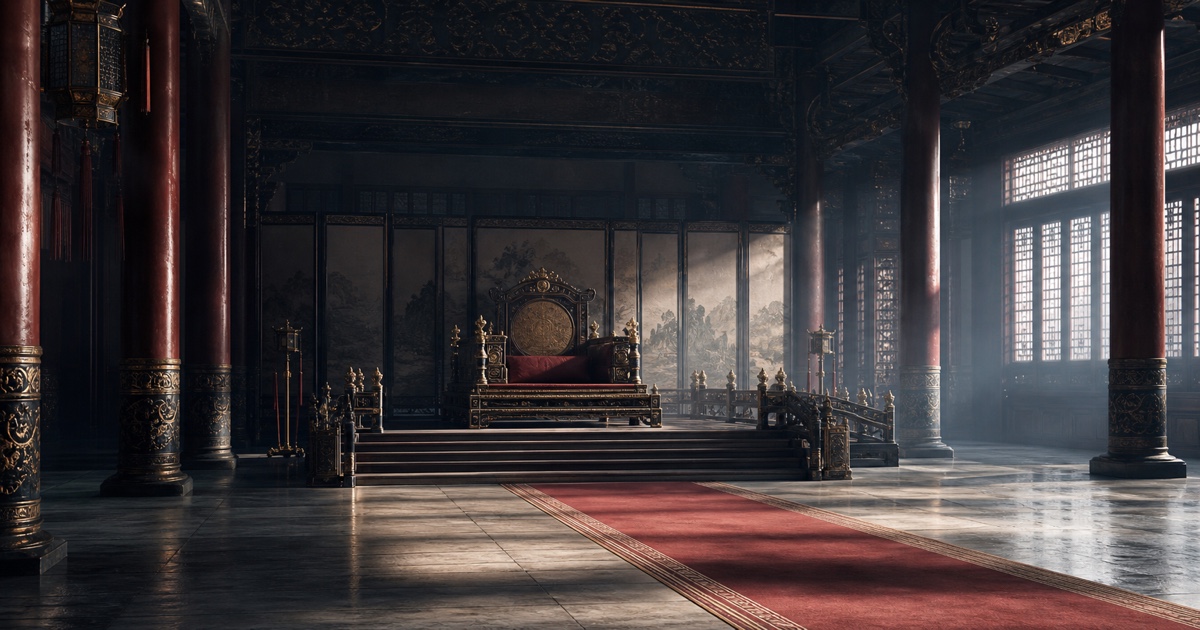
The argument I want to make in this post is not about taste. It is about structure.
When readers ask me why I write tragedies, the easy answer is the one I gave in my earlier piece on No HEA — that I am drawn to literary tragedy, to stories that witness rather than rescue, to endings that close honestly instead of consoling. That is true. But it is only half of the truth.
The other half is harder, and stranger. I write tragedies because the palace will not let me write anything else without lying. When freedom, love, family, and power are forced into the same room, one of them has to give. Palace fiction is the genre that refuses to let any of them give. A happy ending is not impossible there because the author is cruel. It is impossible because the architecture of the world will not bear one without buckling.
That is the case I want to make today.
Four forces that cannot all win in the same room
A palace romance is not a love story dressed in silk. It is the form in which four pressures meet, all of them old, all of them sharper than they look on a paperback cover.
A woman’s freedom. A couple’s love. A family’s needs. The throne’s power.
In ordinary fiction you can arrange these so they cooperate, or at least so the awkward ones step quietly aside. The girl marries the man she chose. Her family approves, or sulks decoratively and is forgiven. No throne is involved, because the story is taking place in a parlor and not in a court. Freedom and love coexist. Family is sentimental backdrop. Power is somewhere else, in another book.
Palace fiction is the genre that puts all four in the same room and refuses to let any of them leave.
Family says: marry where the clan needs you. Freedom says: marry where you want. Love says: I want this one person. Power says: you don’t get to want one. You get the rituals, the consort, the heir, the alliance, the title.
Sometimes family and the throne ally, and crush freedom and love together. Sometimes the throne and love ally, and the family is ruined for it. Sometimes a woman’s freedom briefly negotiates with the throne, and her family pays the bill. The configurations shift. The pressure never lifts.
Remove one of the four and you have something else. A novel where freedom and love win is a coming-of-age. A novel where the family wins cleanly is a dynastic chronicle. A novel where the throne wins cleanly is a political thriller. Palace romance is the form in which all four contend, and the heroine is standing in the middle of them.
She is not standing there because the writer is unkind. She is standing there because that is what the room is.
What a happy ending would cost
It is sometimes useful to argue by negation. So let me try the other side. What would a genuine happy ending require, in any of my three novels?
For A-Jiao in The Emperor’s Caged Bride, an HEA would require the Cui clan to withdraw its claim on her body. To let her go to Prince Ning instead of the Crown Prince. The clan does not do this. The clan cannot do this. After A-Shuo’s death, A-Jiao is the daughter left standing — and a clan that has bound itself to imperial marriage does not release the only remaining daughter back into a private love story. The pressure does not pause for tenderness.
For Yueying in The Cloud Beside the Moon, an HEA would require an Emperor capable of seeing her clearly and a Yueying capable of letting go cleanly. Either one is conceivable in isolation. Both at once is what is needed. The fact that the novel takes twenty years to resolve is itself the evidence that the conditions never align. By the time he sees, she has already become someone who cannot accept the seeing without it costing her the work of two decades.
For Changning in The Emperor’s Last Lie, an HEA would require Li Chengmu to tell her the truth while he was still alive — and for that truth to reach her in time to repair the years she lost in the temple. But the truth he carries is also the truth that would have destroyed her if she had known it earlier. The mercy of the lie and the cruelty of its lateness are the same gesture. You cannot disentangle them without unmaking the man.
In all three, a happy ending is not the writer being kind. It is the writer quietly pretending that one of the four forces took a step back when it never does. The clan loosens its grip. The throne lets a man love without consequence. The years are forgiven. The lie was unnecessary. None of these things happen in the world the books are set in. To write them as if they did is the only real betrayal.
Why happy endings betray the genre
A genre is a contract between writer and reader about what kind of world they are agreeing to inhabit for the next four hundred pages.
When you open a palace novel, you are agreeing to a world where private feeling is observed, where the household is also the state, where a marriage is also a treaty, and where rank is the grammar of every conversation. That is the contract. I wrote a longer piece on what palace fiction actually feels like in A Beginner’s Guide to Chinese Palace Angst — but the contract itself is short.
If, in the last chapters, the writer suddenly allows the couple to ride off into a sunset where none of those pressures follow them, the writer has not been generous. The writer has misrepresented the world she invited you into. The reader bought the book for the kind of world it promised. To get an ending that belongs to a different kind of world is not comfort. It is being told, gently, that the rules you trusted the writer to keep were never quite as load-bearing as she made them look.
I want to be careful here. I am not saying joy is forbidden in palace fiction. Joy is permitted. What is not permitted is joy that pretends the palace is no longer the palace.
A tender afternoon under osmanthus trees is joy the architecture can hold. A friend’s hand quietly taken in a dark room is joy the architecture can hold. A child loved despite the politics arranged around her is joy the architecture can hold. These are real and they belong in the genre. I write them in every book.
What the architecture cannot hold is the wholesale removal of family pressure, succession pressure, imperial possession, or rank. Those things do not get removed. They press, and that press is the story.
Three books, three versions of the same architecture
I write each of my novels with a different geometry. The Emperor’s Caged Bride is a tight first-person trap that closes around one young woman in roughly a year of palace life. The Cloud Beside the Moon is a long revenge arc that takes Yueying twenty years to complete and asks whether the cleanness of her hands matters more than the cleanness of her cause. The Emperor’s Last Lie is a mystery wrapped around a forbidden love, with a heroine pulled back into the palace as a substitute consort after her family’s fall.
Three different rooms. Three different angles of light. The same four forces in every one of them.
In Caged Bride, the force that wins first is family. A-Jiao’s freedom is the price of her clan’s standing. The Cui family has already collected by chapter one — everything that follows is the slow ledger of what that cost her, and what the throne and her own old love do with the daughter the clan has handed over.
In Cloud Beside the Moon, the force that wins first is power. Yueying’s love is the price of her place in the political order. To survive the husband who pushed her down from Crown Princess to Secondary Consort, she has to become someone who can no longer love him simply. Whatever tenderness survives the twenty years is the kind that has been through revenge first.
In Last Lie, the force that wins first is the throne — but it wins by disguising itself as protection. Changning’s truth is the price of the safety Li Chengmu arranged for her. His lies kept her alive through the years that would have killed her. The lies also took the years they might have shared honestly. Mercy and cruelty arrive in the same hand.
Each book uses a different room. The four forces are always present. The geometry of which one wins first, and which one wins last, is how I tell a different story each time without changing the architecture underneath.
When the heroine breaks, the architecture is telling the truth
I want to end on the harder thought.
A happy ending in palace fiction is not a kindness. It is a falsified report. When all four forces are in the room and none of them have stepped aside, the only honest sentence a writer can produce at the end is the one where something has given. The heroine. The marriage. The years. Someone’s hands. The version of the woman who walked into chapter one.
The breaking is what tells the reader that the architecture is real.
That is not pessimism. It is structural honesty. The reader who closes the book having watched a woman crack open under the weight of four pressures she did not ask for walks away knowing something true about how power, love, family, and freedom behave when they are forced into the same room. The reader who closes the book and is told but actually all four agreed to be friends in the end walks away knowing something that is not true.
Comfort, in this genre, is not the comfort of the rescue. It is the comfort of accuracy. The walls did not soften for our convenience. The reader who came here was not lied to. The woman in the phoenix crown was a real woman in a real situation, even if the dynasty around her was an imagined one.
That is what palace romance is for, when it is done with care. Not punishment. Not nihilism. Just a refusal to pretend the room is bigger than it is.
Strip the tragedy out and you do not get a happier palace novel. You get a less honest one. And the reader, who came looking for honesty about what the palace does to a woman, ends up holding a book that quietly tells her the palace does nothing she cannot escape.
The palace does plenty she cannot escape. That is the genre.
What to do next
If you are deciding which of the three rooms to enter first, the Reader’s Guide walks through content notes and where to start. The bookshelf is here when you are ready to pick.
If the structural reading in this post is new to you, the companion essay Why “No HEA” Can Still Be Worth Reading approaches the same question from the reader’s side instead of the writer’s.
And if a rank confuses you in chapter one — that is normal. Keep the Palace Titles Guide open. The grammar of the room is half of the story.
— Tia
A free story for new readers
The Empress He Could Not Keep — a complete short story
of empire, obsession, and the impossible return.
Yours when you join the reader list.