The Music I Wrote These Books To
The writing soundtrack behind Tia Shan's three palace tragedies: guqin, rain, cello, silence, and the emotional cues behind each book.
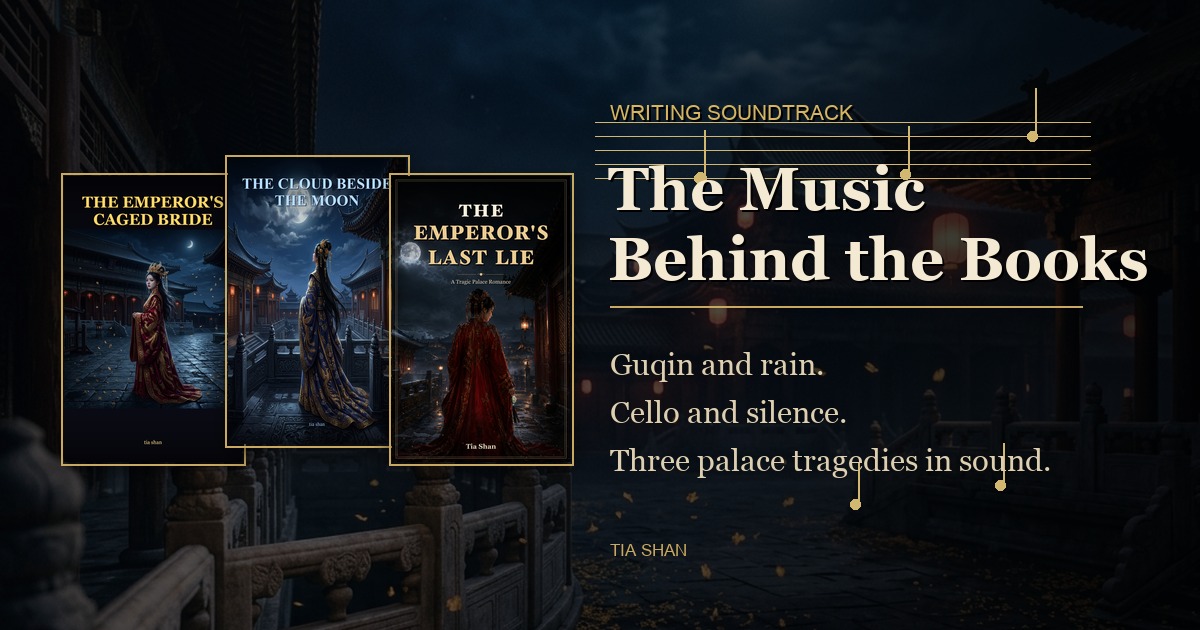
I do write to music, but not in the romantic, candlelit way people sometimes imagine. Most of the time, I am hunting for a pressure system. A sound has to put me back inside the room quickly: the girl beside the osmanthus wine who already knows the door is closing, the empress listening to rain after a friend’s death, the woman at a temple gate trying to decide whether the truth will save her or finish breaking her. I do not need lyrics telling me what to feel. I need instruments that leave space for withheld speech. For these three palace tragedies, the private soundtrack became guqin, rain, low strings, temple bells, and the most difficult instrument of all: silence.
Light-to-medium spoilers follow for atmosphere, symbols, and emotional arcs across all three books. I avoid final reveals, but I do name several early-to-mid story wounds.
First, a confession about playlists
This is not a neat public playlist where every track can be pinned down forever. My writing music changes by draft, so instead of pretending the books have one official soundtrack, I think of them as nine writing cues.
If you want to build a listening queue while reading, search by sound rather than by title: guqin nocturne, rain on palace stone, slow erhu, dark academia piano, low cello drone, Buddhist temple bell, winter wind ambience. The point is to enter the emotional weather of the books.
| Book | Writing cue | Sound |
|---|---|---|
| The Emperor’s Caged Bride | Osmanthus wine under a full moon | Guqin, soft flute, one clear bell |
| The Emperor’s Caged Bride | The wrong name behind the veil | Sparse piano, held breath, low strings |
| The Emperor’s Caged Bride | Weiyang Palace after the gates close | Slow cello, cold room tone |
| The Cloud Beside the Moon | Rain on the Eastern Palace roof | Guqin and rain |
| The Cloud Beside the Moon | Mianmian’s cloud | Erhu, high strings, almost no percussion |
| The Cloud Beside the Moon | The moonlit almost | Piano, unresolved harmony |
| The Emperor’s Last Lie | Anyuan Temple after seven years | Solo cello, distant bell |
| The Emperor’s Last Lie | Ash in Baoxian Pavilion | Low strings, crackling fire, silence after impact |
| The Emperor’s Last Lie | The road back too late | Cello and near-silence |
Book 1: a bright moon before the door shuts
The Emperor’s Caged Bride begins, emotionally, before the palace has fully claimed A-Jiao.
The sound I associate with the opening is not grand imperial music. It is something younger and more fragile: guqin under a full moon, a thin flute line, the quiet clink of cups. A-Jiao and Prince Ning drink osmanthus wine at Qingliang Hall, and the moment has the ache of a memory becoming precious before anyone understands it is already over. The fragrance is sweet. The moon is beautiful. The young people still have names that belong to themselves.
That is why the music cannot be too tragic yet. A-Jiao is not born tragic. She is lively, stubborn, foolish in ordinary teenage ways, and still capable of believing that asking a question might change her fate. The music needs enough brightness for the reader to feel what the palace takes.
Then comes the second cue: the wedding veil and the wrong name.
This is where I move from guqin to sparse piano and low strings. A palace wedding should sound ceremonial, but A-Jiao’s wedding night is not a celebration. It is a misrecognition. She is seen as another woman before her own marriage has even begun. The sound should feel too close: one note repeated until the whole future narrows to the space between one name and another.
The third cue for this book is Weiyang Palace after the gates close.
I wrote more about that space in Why Weiyang Palace Is a Golden Cage, because it is one of the places where the novel’s emotional architecture becomes visible. Weiyang is beautiful, but beauty does not soften captivity. For those scenes, the music has to lose ornament. Slow cello works better than anything too decorative. A low string line can make a room feel large and airless at the same time.
By the time A-Jiao is confined, the osmanthus wine has changed its meaning. What once sounded like youth now returns as a ghost. That is the shape of Book 1’s soundtrack: begin with fragrance and moonlight, then let every beautiful sound come back colder.
Book 2: guqin, rain, and a moon that will not forgive
If The Emperor’s Caged Bride is built around a door closing, The Cloud Beside the Moon is built around rain.
Yueying’s book needs guqin because guqin can sound restrained even when it is full of grief. It does not beg the listener to cry. It leaves grief upright. That matters for Yueying, whose wound is not only that she has been hurt. It is that the palace keeps asking her to translate that hurt into proper behavior.
The first cue is rain on the Eastern Palace roof. It belongs to the stretch of the book where desire, rank, illness, and household politics begin braiding together. Everyone is listening for footsteps. Everyone is counting visits. Everyone knows that a bowl of medicine, a night of favor, or a rumor moving through the corridor can become a weapon. The music needs pattern: plucked strings, repetition, a sound that understands calculation.
The second cue is Mianmian’s cloud.
Mianmian could have been written as only the bright, lovesick girl who does not know how dangerous sincerity is. But to me, she is the book’s first true witness. She loves badly, perhaps unwisely, but she loves without calculation. When she imagines becoming the cloud beside Yueying’s moon, the soundtrack has to become almost unbearably light.
This is where erhu can work, if used carefully: a thin line in the upper register, something that seems to be disappearing as it plays. It should feel like a promise made by someone who no longer has the power to keep promises.
I wrote about that image more fully in The Meaning of the Moon and Cloud. For the soundtrack version, the important thing is this: Mianmian’s music should not belong to the Crown Prince. It should belong to Yueying. Her final tenderness points toward her friend, not toward the man the palace taught everyone to orbit.
The third cue is the moonlit almost. Yueying looks at the man she has spent years refusing to love, and for one instant she understands the life that might have existed if the beginning had not been ruined. The music here should not swell. A swell would make it sound like surrender. I hear it as piano instead: a few notes, an unresolved harmony, the feeling of a hand almost reaching and then choosing not to.
That unresolved chord is Yueying’s moral center. She does not refuse tenderness because she is incapable of feeling. She refuses because feeling has a cost, and she knows exactly who would be asked to pay it.
Book 3: cello and silence
The Emperor’s Last Lie is the cello book.
It is the cello book because a cello can sound like a human voice trying not to say the thing it knows. Changning and Li Chengmu live inside withheld truth. Their story begins after too much has already happened: childhood love, political ruin, temple exile, a return to the palace, and the strange cruelty of being treated as a substitute for someone else.
The first cue is Anyuan Temple after seven years.
For Changning, the temple is not pure peace. It is absence. It is survival with the volume lowered. A distant bell works here, but only if it is not too serene. When the Emperor pulls her back into the palace, the music should not become triumphant. It should sound like a door opening onto weather she remembers too well.
The second cue is ash in Baoxian Pavilion.
Book 3 has a mystery structure, but its clues are not only clues. Letters burn. Witnesses vanish. Women are turned into mirrors, shields, blades, and decoys. The palace becomes an archive where someone has been destroying pages. For those scenes, I like low strings with almost no melody, plus the dry sound of fire. The point is evidence becoming unreachable.
This is also where silence becomes part of the music. A revelation can be less powerful if the soundtrack tells the reader how to react too soon. Sometimes the right sound after a burned letter is nothing. Let the room go quiet. Let the reader notice that the absence itself has weight.
The third cue is the road back too late.
I will not explain the late-book context here, because The Emperor’s Last Lie depends on the reader discovering how its truths rearrange blame. I will say only this: the emotional shape of the final movement is not a love confession. It is a delay becoming permanent.
For that, I want cello and near-silence. A single line, no percussion, no obvious climax. The tragedy is not that nobody loved enough. It is that love kept arriving through secrecy, strategy, protection, and delay, until the future everyone kept postponing had quietly run out.
If you want the spoiler-light doorway into this book, start with Three Books, Three Palaces. It explains where Changning’s story sits beside A-Jiao’s slow heartbreak and Yueying’s long revenge without opening the final locked room.
Why the soundtrack stays restrained
I avoid tragic music that tells the listener, “This is sad. Please feel sad now.” The palace is already dramatic: crowns, titles, executions, pregnancies, banquets, sealed gates, burning pavilions, deathbeds, and imperial edicts. If the prose and the music both reach for grandeur at the same time, the scene can become too polished to hurt. I prefer restraint because the characters themselves are restrained. They often have to bow, smile, pour tea, accept a title, refuse a question, or wait until night to mourn.
So the music has to respect that.
Guqin helps because it leaves space between notes. Rain helps because it gives grief a pattern without giving it an answer. Cello helps because it can carry warmth and dread in the same breath. Silence helps because some truths in these books are not softened by being beautifully scored.
That is also why the three books sound different to me even though they share a shelf.
A-Jiao’s book begins with sweetness curdling into captivity. Yueying’s book is rain, calculation, and moonlight held at a distance. Changning’s book is the low note underneath a lie someone has mistaken for mercy.
Together, they make a small private orchestra of women trying to survive rooms built by other people.
What to do next
If you want to read with this mood map beside you, start at the Books page and choose the sound that calls to you: osmanthus and a locked palace for The Emperor’s Caged Bride, guqin and rain for The Cloud Beside the Moon, or cello and silence for The Emperor’s Last Lie.
If you need content notes first, the Reader’s Guide is the gentler doorway. If you want one practical companion before entering the inner palace, the Palace Titles Guide will help you understand why a rank, a form of address, or one seat at a banquet can wound as sharply as a confession.
And if you listen while reading, keep one rule in mind: do not choose the prettiest song.
Choose the one that makes the room feel impossible to leave.
- Tia
A free story for new readers
The Empress He Could Not Keep — a complete short story
of empire, obsession, and the impossible return.
Yours when you join the reader list.