The Palace Is Cruel. The Women Are Still Funny.
A-Jiao's temper, Wen Shuer's mischief, Consort Wan's fake illnesses—and why humor belongs inside Tia Shan's darkest palace stories.
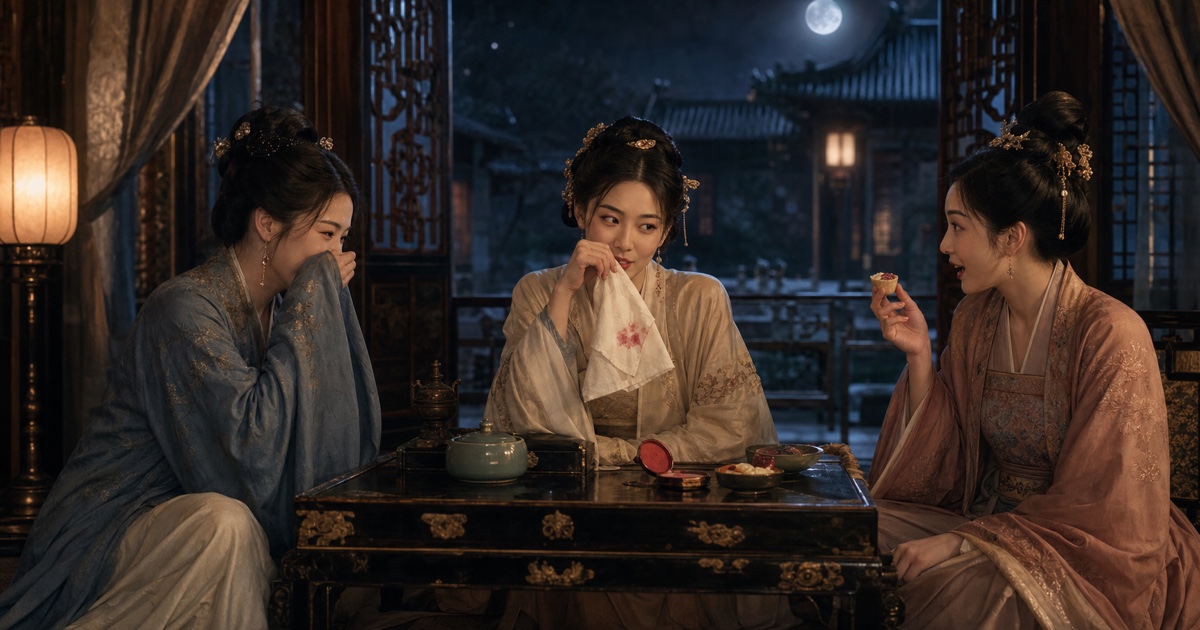
I know what my covers promise. Moonlight, locked gates, a woman in red, probably no one having a nice time. All true. Still, the books would be unbearable to me if the women were solemn on every page. People joke in bad marriages. They gossip at funerals. They make faces behind the backs of important men. A palace does not remove that impulse; it gives it better hiding places. One of my favorite moments in The Emperor’s Last Lie involves Consort Wan using cinnabar to fake blood so she can escape a crowd. The scheme is sad if you stand back. Up close, it is also very funny. She survives a few sentences, shakes her red handkerchief, announces that she is dying, and leaves. I love her for that.
A small spoiler note: This essay mentions character dynamics and scenes from all three books, but it does not reveal any of the endings.
A-Jiao was funny before she became tragic
It is easy to remember A-Jiao in Weiyang Palace and forget the girl who came before it.
Young A-Jiao has very little control over her face. She sulks. She blurts things out. She laughs at other people’s misfortune with the shameless confidence of someone who has not yet learned that the room may one day turn on her. A-Shuo teases her for having a head full of strange ideas. The people who love her know she can be thoughtless, spoiled, warm, and impossible to keep dignified for long.
I needed that girl on the page before I could make her Empress.
Without her, the story would begin with a victim already arranged beneath glass. The reader would see the cage and understand the symbolism, but there would be less sense of what the cage had taken. A-Jiao’s early ridiculousness is part of the loss. Weiyang Palace confines her, then teaches a girl who once laughed too loudly to watch every expression before it reaches her face.
There is humor later too, although it grows sharper. Wuzhu can still tease her. A-Jiao can still notice the absurdity of ceremony, especially when everyone around her is behaving as if a miserable arrangement has become respectable merely because the correct robes arrived. Her private voice never becomes as obedient as her public body.
That stubborn private voice is one reason I think of her as more than a passive heroine. I wrote about the rest of that tension in Cui Jiao — The Girl Beneath the Phoenix Crown. The crown changes what she may do. It never completely fixes her personality.
Wen Shuer cannot keep a secret quietly
Wen Shuer enters The Cloud Beside the Moon looking gentle enough to disappear behind everyone else. She speaks softly. She sits properly. Even her name seems to promise good manners.
Then she becomes comfortable with Yueying.
The quiet girl turns out to be a terrible gossip. She leans closer, lowers her voice, glances around the room, and reveals that she knows a great deal. When Yueying tries to protect her by keeping her out of palace schemes, Shuer puffs out her cheeks and protests. Timid does not mean stupid, and she would like that entered into the record.
My favorite Shuer scenes often begin with her looking harmless and end with someone else discovering that she has already set a plan in motion. After Madam Qin scratches Yueying’s face, Shuer rushes in like an angry little rabbit, inspects the wound, declares that the Qin side is finished, and flies out before Yueying can stop her. By the next morning, Shuer has engineered a servant quarrel clever enough to bring senior palace authority down on Madam Qin.
She is delighted with herself. Yueying is horrified.
That difference makes the scene work for me. Shuer thinks she has finally become brave enough to protect her friend. Yueying sees another bright-hearted woman stepping into danger on her behalf. The joke and the fear occupy the same room.
Their friendship would feel flatter without the pastries, the gossip, the swing, and Shuer’s solemn belief that she is being extremely subtle. Affection is built out of time wasted together. Palace women do not spend every hour delivering speeches about loyalty. Sometimes one of them eats while the other complains.
If you want the darker side of those relationships, Female Friendship as Palace Warfare follows what happens when tenderness becomes leverage. Here, I only want to leave Shuer with her cheeks puffed out for another minute.
Changning and Yinyuan keep failing to behave
Of the three books, The Emperor’s Last Lie may have the most openly funny narrator. Changning has already survived too much to be impressed by rank. Unfortunately for Yinyuan, she is also unable to keep that opinion inside her head.
Yinyuan begins as a maid furious about her assignment. She once served a great favorite; now she has been given a previously married, bottom-ranked Second Attendant with no visible prospects. After Changning explains the situation honestly, Yinyuan wears her contempt in plain view. Snapping at her mistress becomes one of the few pleasures available in their two-person household.
It suits them both.
Changning says something dangerous. Yinyuan sweats. Changning notices the sweat and promises herself she will behave. The Emperor asks one more question. Yinyuan gives her a final, desperate look. Changning immediately says the dangerous thing anyway.
Their exchanges make the palace feel inhabited rather than staged. Yinyuan worries about rewards, collects gossip on every errand, and cannot understand why her mistress keeps treating imperial favor like an inconvenience. Changning gives away a jade pendant without realizing that a personal object from the Emperor is not an ordinary tip. Yinyuan nearly throws it back as if it has caught fire.
Then there is Consort Wan.
Everyone thinks Consort Wan is too sick to matter. She has encouraged that conclusion for years. Illness lets her stay in bed, avoid visitors, miss ceremonies, and appear politically useless. When Changning’s residence fills with people celebrating a promotion, Consort Wan lasts only long enough to make the visit proper. Out comes the cinnabar. Up comes the handkerchief. Another alarming decline in health. What a pity. She must go home at once.
It is theater, and the audience falls for it because they already prefer the role she has chosen. The palace sees a weak woman. Consort Wan sees an exit.
The joke is often a hiding place
The jokes tell me who has seen through the rules.
Changning jokes because ceremony no longer convinces her. Yinyuan jokes because complaint is safer than despair. Consort Wan turns frailty into such a complete performance that powerful people stop looking for a mind beneath it. Wen Shuer’s innocent chatter allows her to hear things sharper women might never be told. A-Jiao’s impulsive humor is the part of girlhood the palace never manages to educate out of her completely.
None of them would describe this as a strategy workshop. They are tired. Something is ridiculous. Someone says so.
Palace fiction can become so polished that every woman seems born knowing how to deliver a devastating line beneath a flowering tree. Real intimacy is messier. Friends repeat themselves. Maids roll their eyes. A woman commits to an undignified lie because she wants to go back to bed.
The laugh does not cancel the danger. Often it shows exactly how close the danger is. Only people living under impossible rules become this inventive about finding ten minutes alone.
I need them alive before I can hurt them
There is a selfish craft reason for all of this. Tragedy works better when the doomed person has been allowed to be funny.
If a character arrives already dressed for mourning, the reader knows where to place her. If she has preferences, bad habits, petty grudges, and a joke she cannot resist, loss becomes harder to tidy away. I do not want A-Jiao remembered only as the woman inside the golden cage. I want the girl who laughed at the wrong moment to remain beside her. I do not want Shuer reduced to what palace politics eventually costs. I want her plotting over pastries. I do not want Consort Wan’s illness read only as weakness. Sometimes the handkerchief is stained with cosmetic powder, and she has somewhere quieter to be.
The palace is cruel. The women notice. Every now and then, one of them makes another woman laugh before the doors close again.
If this is your first visit, the Complete Reader Companion will help you choose which tragedy to enter first. For content notes, tropes, and reading order, use the Reader’s Guide. If Changning, Yinyuan, and the magnificently unreliable Consort Wan sound like your kind of company, The Emperor’s Last Lie is on Kindle and Kindle Unlimited.
— Tia
A free story for new readers
The Empress He Could Not Keep — a complete short story
of empire, obsession, and the impossible return.
Yours when you join the reader list.