Why The Emperor's Caged Bride Is Bittersweet, Not Romantic Redemption
A spoiler-heavy reading of why The Emperor's Caged Bride's final truth is bittersweet without becoming romantic redemption.
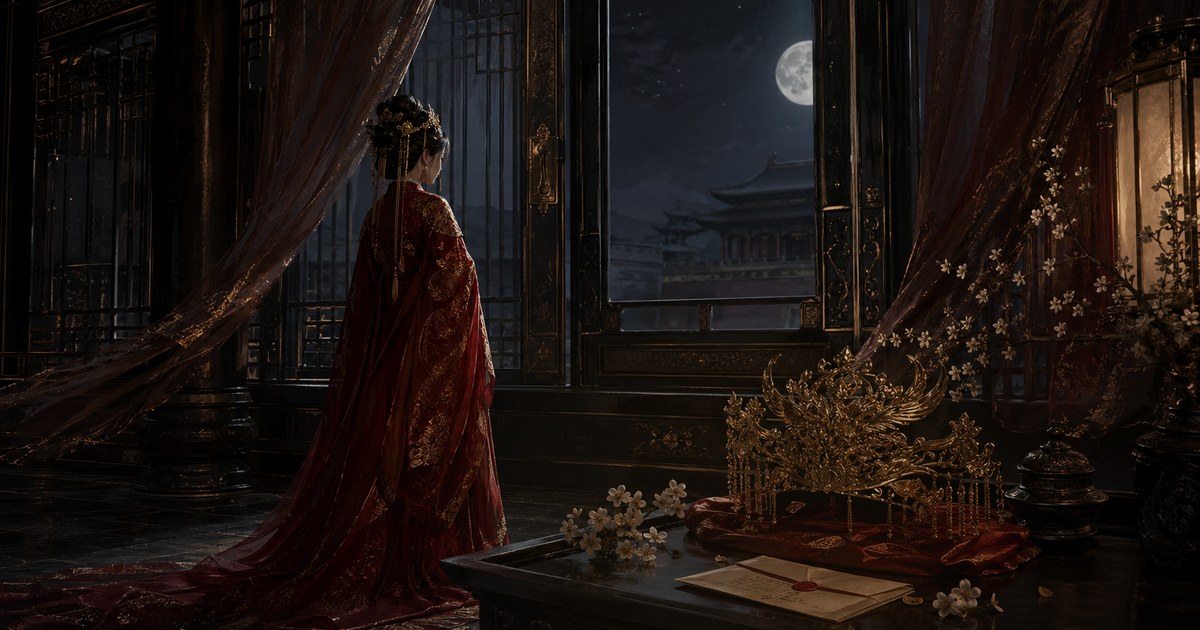
I understand the impulse to look at the ending of The Emperor’s Caged Bride and reach for the softest possible reading. He loved her. He mourned her. He never installed another Empress after her death. He was buried beside her, and in the final scene, the truth comes out at last: the woman he had always loved was A-Jiao. There is tenderness in that. There is ache. There is the terrible beauty of a life understood only after it has already been lost. But I want to be careful about the word readers sometimes place over that feeling. Bittersweet is not the same as romantic redemption. A truth can make an ending hurt more without making the harm forgivable.
Major spoiler warning: This article discusses A-Jiao’s death, the Emperor’s final confession, his burial with A-Jiao, Prince Ning, A-Shuo, and the novel’s last emotional reveal. Read The Emperor’s Caged Bride first if you want the ending unspoiled.
Bittersweet is an aftertaste, not a verdict
Bittersweet endings are dangerous because they feel close to consolation. They leave one hand on grief and one hand on longing. They say: something was wasted, but not everything was empty.
That is the emotional weather of The Emperor’s Caged Bride. The ending is not blank cruelty. It does not reveal that A-Jiao meant nothing. It reveals the opposite, which is almost worse. The Emperor loved her all along, and still she died believing she had been a failed substitute for A-Shuo.
That is why I call the ending bittersweet. The sweet part is the existence of feeling. The bitter part is the timing, the silence, the violence, and the fact that A-Jiao never receives the truth in a form that can return her to herself. Bittersweet is a flavor. It is not an acquittal.
What readers want the twist to repair
The final twist is emotionally powerful because it changes the story we thought we were reading. For most of the novel, A-Jiao believes the Emperor’s heart belongs to A-Shuo, her dead cousin and his first wife. On her wedding night, A-Shuo’s name stands between bride and groom. Later, A-Jiao studies A-Shuo’s habits because she thinks imitation is the only way to survive her marriage.
I explained that reveal in The Final Twist in The Emperor’s Caged Bride, Explained. Here, I want to linger on what the twist cannot do.
It cannot give A-Jiao back the years she spent erasing herself. It cannot make the wedding night safe. It cannot unexile Prince Ning, undo the threats, open Weiyang Palace, or turn the Emperor’s jealousy into care.
The twist answers whom he loved. It does not answer the more important moral question: what did his love do?
The damage happened before the truth
Redemption requires more than hidden feeling. It requires recognition while recognition can still change the living arrangement of the people involved. A-Jiao does not get that.
By the time the Emperor’s mask breaks, A-Jiao has already been moved from girlhood into marriage, motherhood, political duty, and confinement. She has watched the old possibility of Prince Ning be punished. She has learned that even her title as Empress cannot guarantee movement, mercy, or safety.
The truth arrives when she is dying.
That matters. A confession delivered at the edge of death may reveal the speaker’s heart, but it does not automatically become healing for the person who needed the confession years earlier. A-Jiao is not given time to ask questions, refuse him, forgive him, hate him, or decide what the truth means.
She dies still reaching for the word that names the wrongness of the whole marriage: brother-in-law. The word is not a romantic obstacle. It is a moral fact. Ceremony could make the match legal, but it could not make the history disappear. His late tenderness cannot erase it either.
Love through power is still power
The Emperor’s tragedy is not that he feels nothing. A simpler villain would be easier to judge and easier to forget.
The harder truth is that he feels deeply, but his feeling passes through the machinery of rank. He is not only a husband. He is the sovereign. When he is jealous, a rival can be exiled. When he is afraid, a household can be threatened. When he wants A-Jiao to live, he reaches for the same old lever: Prince Ning’s life.
That is why his love cannot become redemption merely by being real. Real love can still be possessive. Real love can still be cowardly. Real love can still use fear because fear works faster than trust.
His affection often appears in forms that leave A-Jiao with less room to breathe. He wants her close, so closeness becomes confinement. He wants proof that she belongs to him, so her old tenderness for Prince Ning becomes dangerous.
As I wrote in The Emperor in The Emperor’s Caged Bride, his love explains the cage, but explanation is not redemption.
Without that refusal, the final reveal becomes a shortcut: he loved her, therefore the pain was meaningful. But suffering after the fact is not accountability.
Remorse cannot give back choice
I believe the Emperor’s remorse: his grief when A-Jiao dies, the lonely years afterward, the decision never to install another Empress, and the burial beside her that tells history what he failed to tell her in life.
None of that gives A-Jiao back the thing she was denied from the beginning: choice. She did not choose the marriage, the role of A-Shuo’s successor, the politics that made her body useful to the Cui clan, or the confinement that reduced Weiyang Palace from seat of honor to gilded prison.
If the ending were romantic redemption, the story would need to return agency to her while she could still use it. The Emperor would need to recognize the harm and change her life while A-Jiao was alive enough, clear enough, and free enough to answer.
Instead, the most beautiful gestures occur after her agency has vanished from the world.
This is why the burial image is so painful. To be buried together is not the same as being allowed to live together well. To be mourned forever is not the same as being heard in time. A tomb can preserve devotion, but it cannot retroactively create safety. A-Jiao deserved safety before she became a memory.
Why the ending still hurts tenderly
So why does the ending feel tender? Because tragedy is not made only from punishment. It is also made from waste.
The novel hurts because something real existed inside the ruin. The Emperor’s final grief tells us that A-Jiao was not foolish for sensing some hidden pressure beneath his cruelty. A-Miao’s epilogue gives the reader the witness A-Jiao never had.
There is tenderness in being witnessed. There is also rage. Both feelings belong. If you only rage, you miss the ache of the love that could have been ordinary in another life. If you only soften, you miss the young woman who paid for his silence with her own life.
This is the balance I return to across the three palace tragedies. Yueying in The Cloud Beside the Moon and Changning in The Emperor’s Last Lie both receive late understanding too. It matters. It simply does not undo the life that came before it.
The moral shape of bittersweet
For me, the ending of The Emperor’s Caged Bride is bittersweet because it preserves two truths at once: the Emperor loved A-Jiao, and the Emperor harmed A-Jiao. Neither truth cancels the other. In fact, the tragedy depends on holding both.
If he had never loved her, the story would be colder. If love automatically redeemed him, the story would be dishonest.
That is why I resist calling the ending romantic redemption. Redemption would move the moral center toward the person who harmed her: his grief, his regret, his secret devotion, his suffering after she dies. Bittersweet tragedy keeps the center where it belongs: with A-Jiao.
The question is not whether he loved her enough to suffer. The question is whether his love ever made her freer, safer, or more fully herself while she was alive.
The answer is no.
And yet, when the final page reveals that she was loved, the grief changes color. That is bitter. That is sweet. That is not forgiveness.
What to Do Next
If this article helped you name the ending, continue with The Final Twist in The Emperor’s Caged Bride, Explained for the full reveal, or Cui Jiao Character Study for A-Jiao before the ending consumes her.
If you are deciding whether to enter Weiyang Palace at all, start with the Reader’s Guide for content notes, then find The Emperor’s Caged Bride on Kindle and Kindle Unlimited.
And if you came here wanting the Emperor to be redeemed, I would ask one more question before you go:
Can a love story be beautiful and still fail the woman it claims to love?
- Tia
A free story for new readers
The Empress He Could Not Keep — a complete short story
of empire, obsession, and the impossible return.
Yours when you join the reader list.