The People Who Remember — Servants, Witnesses, and Palace Truth
How maids, eunuchs, and physicians preserve the truths that official palace histories are designed to erase.
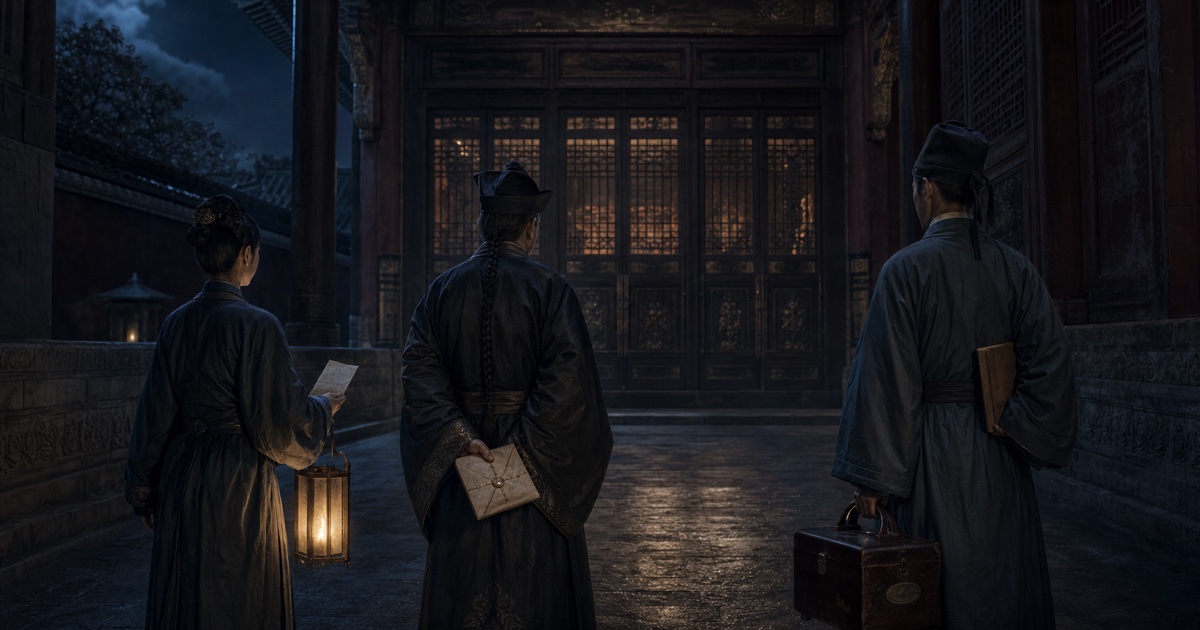
When I write a palace scene, I am rarely interested only in the two powerful people speaking at its center. I am also thinking about the maid lowering the bed curtains, the eunuch waiting beyond the door, the physician whose hand has just left a woman’s pulse, and the servant ordered to carry a message no one will admit was sent. The official record belongs to rulers. Memory belongs to the people who poured the wine, changed the lamps, washed the blood from a sleeve, and learned when not to lift their eyes. Across my three palace tragedies, truth survives because someone considered unimportant was present. The palace may treat servants as furniture. The story cannot.
Spoiler warning: This essay discusses major events from all three novels, including deaths, hidden testimony, medical manipulation, and the final revelation of The Emperor’s Last Lie. Each book section is marked separately so you can stop before a novel you have not finished.
The palace keeps two archives
One archive is official. It contains decrees, ranks, charges of treason, promotion records, pulse records, mourning instructions, and the approved account of who betrayed whom. This archive has seals. It has dates. It is meant to survive.
The second archive is human. A maid remembers the exact sentence that broke her mistress’s heart. A eunuch knows the Emperor was behind a door while an Empress begged outside it. A physician knows whether an illness is natural, induced, exaggerated, or politically convenient. A wet nurse can tell who actually soothed a child at night even when the genealogy later names someone else as Mother.
That second archive is more fragile, but often more truthful. The people who hold it can be dismissed, bought, threatened, poisoned, banished, or killed. Their knowledge matters precisely because it was never supposed to become history.
If the ranks themselves are unfamiliar, the Palace Titles Guide explains why a servant’s position near a door can matter almost as much as a consort’s place in a ceremonial hall.
Book one spoilers: the people outside Weiyang Palace
In The Emperor’s Caged Bride, Wuzhu’s importance is easy to overlook because her loyalty is made of small actions. She dresses A-Jiao, steadies her when the floor seems to fall away, adds a quilt when the palace turns cold, and keeps speaking to her as a person after the Emperor has reduced her to a confined title.
Wuzhu cannot revoke the confinement order. She cannot reopen the gate or restore the Cui clan. What she preserves is A-Jiao’s private reality. The official version says Empress Cui became violent and was confined. Wuzhu knows what the years inside Weiyang Palace felt like: which letters stopped arriving, which hopes thinned out, and how long endurance had been mistaken for safety.
Eunuch De occupies a more compromised place. He carries the Emperor’s commands, tries once to soften his anger, then continues serving the power that enforces A-Jiao’s isolation. Because he controls access, he knows who is waiting, who is refused, and which delay is deliberate. He is not free to turn knowledge into justice. His survival depends on translating imperial will into polite palace procedure.
Then Lanxin arrives at Weiyang Palace with blood on her forehead, begging for help for Consort Dowager Xu. She has already gone to the Imperial Medical Bureau. She knows the physicians are refusing treatment because Prince Ning has fallen from favor. A-Jiao’s phoenix seal should be enough; it is not. Lanxin’s testimony reveals what no medical record would say plainly: the woman is not simply dying from illness. She is being allowed to die.
Lanxin has the truth and no authority. A-Jiao has a title and no usable authority. The tragedy happens in that gap.
This is why Weiyang Palace is a golden cage. Its walls control not only the woman inside, but which witnesses can reach her and which messages can leave.
Book two spoilers: the maid who remembered every word
The most consequential testimony in The Cloud Beside the Moon does not come from a minister, an imperial investigator, or the Crown Prince. It comes from Yingying, Hu Mianmian’s personal maid.
After Mianmian’s death, Yingying is supposed to return to the Hu family with the dowry and accompanying servants. She could leave quietly. Instead, she stays until Yueying notices that she has something she is afraid to say. Once the room is cleared, Yingying accuses the Crown Princess of feeding Mianmian’s lovesickness rather than comforting it.
Rong-niang immediately asks the necessary question: where is the proof?
Yingying’s answer is memory. She distinguishes the harmless stories told when Yueying was present from the more carefully chosen stories told when Mianmian was alone. She remembers the visits, the timing, and the sentences spoken loudly enough to be overheard. Most of all, she remembers what those sentences did to the woman she served. She insists that she would not dare forget a single word, even in death.
That testimony changes Yueying’s life. It does not create her grief, but it gives grief a direction. The revenge plot begins because a maid preserves a pattern that powerful people could dismiss as ordinary conversation.
Rong-niang becomes a different kind of witness. She does not merely observe Yueying’s transformation; she helps carry it out. She retrieves the Crown Princess’s pulse records, bars doors, searches rooms, manages servants, and recognizes when Yueying has crossed a line that cannot be uncrossed. Her loyalty protects Yueying, but it also makes her an accomplice.
The physicians belong to the same information system. A pulse can reveal pregnancy, illness, poison, or infertility. Yet a diagnosis is never neutral once rank enters the room. Physician Jia’s knowledge becomes evidence, bait, and leverage depending on who controls the consultation. The body may tell the truth. The palace still decides who is allowed to interpret it.
For the fuller moral cost of that transformation, continue with the Ruan Yueying character study or Twenty Years of Revenge.
Book three spoilers: the silent witness who writes history
The Emperor’s Last Lie makes the human archive most literal.
At first, Yinyuan gives Changning the palace’s public memory: which consort rose, which woman disappeared, which injury was called an accident, and which rumor everyone sees but no one discusses. Eunuch Wei holds a more dangerous layer. He understands the Emperor’s habits, controls doors and announcements, carries decrees, and often recognizes Li Chengmu’s intention before Changning does. Neither possesses the whole truth. Each provides fragments.
Youbai possesses the truth from beginning to end.
Before she became Consort Mao, Youbai was Changning’s maid and the Tong family’s agent beside Crown Prince Chengyu. She witnessed the conspiracy that pushed the Crown Prince toward rebellion and destroyed the Tong clan. Because her knowledge could overturn the official moral order of the new reign, Noble Consort Yi has her poisoned until her voice is ruined. Her mother’s life is used to keep her obedient.
Silencing Youbai does not erase what she knows. It changes the form in which the truth must survive.
At Zhaoren Temple, after discovering that her last relative has already been murdered, Youbai spends years learning to write. She leaves a letter for Changning and builds a test around it: the letter must reach the correct Lady Ye, and that woman must name what she expects to find before the seal is broken. Youbai understands that testimony without control can become another weapon. She protects not only the letter, but its reader.
By the time Changning receives it, Youbai is dead. Her crooked handwriting does what her poisoned voice could not. It restores the erased chain of cause and guilt: Changning’s father sacrificed his own clan to save the woman he loved and her son, while Li Chengmu accepted Changning’s hatred rather than tell her that she had been discarded by her own family.
The Emperor’s last lie is preserved by a maid’s last letter.
That is the cruel reversal at the heart of the book. The ruler controls the official story, yet the lowest-status witness delivers the final truth. If you have finished the novel, The Last Lie — Why Some Tragedies Disguise Themselves as Mercy follows what Li Chengmu chooses to keep silent and why.
Witnessing is not innocence
I do not write servants as a single moral class. Proximity to suffering does not automatically make anyone good.
Some servants protect. Some exploit the small authority of a gate, tray, medicine bowl, or whispered rumor. Some obey because refusal would mean death. Some turn loyalty into complicity. A physician can preserve life or make neglect look natural. A maid can carry comfort or poison. A eunuch can soften an order, delay a meeting, or ensure that cruelty arrives with perfect ceremonial manners.
This moral range matters. If every servant were secretly wiser and kinder than every ruler, they would become another fantasy. Palace systems do not corrupt only the people at the top. They distribute tiny pieces of power downward, then make everyone calculate what those pieces can buy.
The difference is that servants rarely get to write the verdict afterward.
What the throne cannot erase
Official history likes complete sentences: she was guilty; he restored order; the clan rebelled; the consort died of illness. Human memory is less orderly. It keeps the pause before an order, the unanswered night outside a door, the words repeated until a lonely woman stopped eating, and the letter written by a witness who had already lost her voice.
That is why these characters matter to me. They are not background realism placed around the imperial family. They are the route by which private suffering becomes knowable at all.
If you are new to the books, use the Complete Reader Companion to choose a spoiler-safe entrance. If Youbai’s letter is the thread you want to follow, The Emperor’s Last Lie is available on Kindle and Kindle Unlimited. For content notes across all three novels, begin with the Reader’s Guide.
The palace writes the decree. Someone at the edge of the room remembers what it cost.
— Tia
A free story for new readers
The Empress He Could Not Keep — a complete short story
of empire, obsession, and the impossible return.
Yours when you join the reader list.